How to Use Leverage in Forex: A Beginner’s Guide


- Forex leverage = controlling a larger position than your account balance by borrowing from the broker; expressed as a ratio (50:1, 100:1, 500:1)
- Amplifies both gains and losses equally; 100:1 leverage means a 1% adverse price move = 100% loss of the margin used for that trade
- Margin = the deposit required to open a leveraged position; it is a good-faith deposit, not the full trade value
- Regulated retail leverage caps: US (CFTC/NFA) = 50:1 major pairs, 20:1 minors; EU/UK (FCA/ESMA) = 30:1 major pairs; offshore brokers often advertise 500:1 or higher
- Higher leverage is not a feature - it is a risk multiplier; 500:1 means a 0.2% adverse move eliminates the entire margin
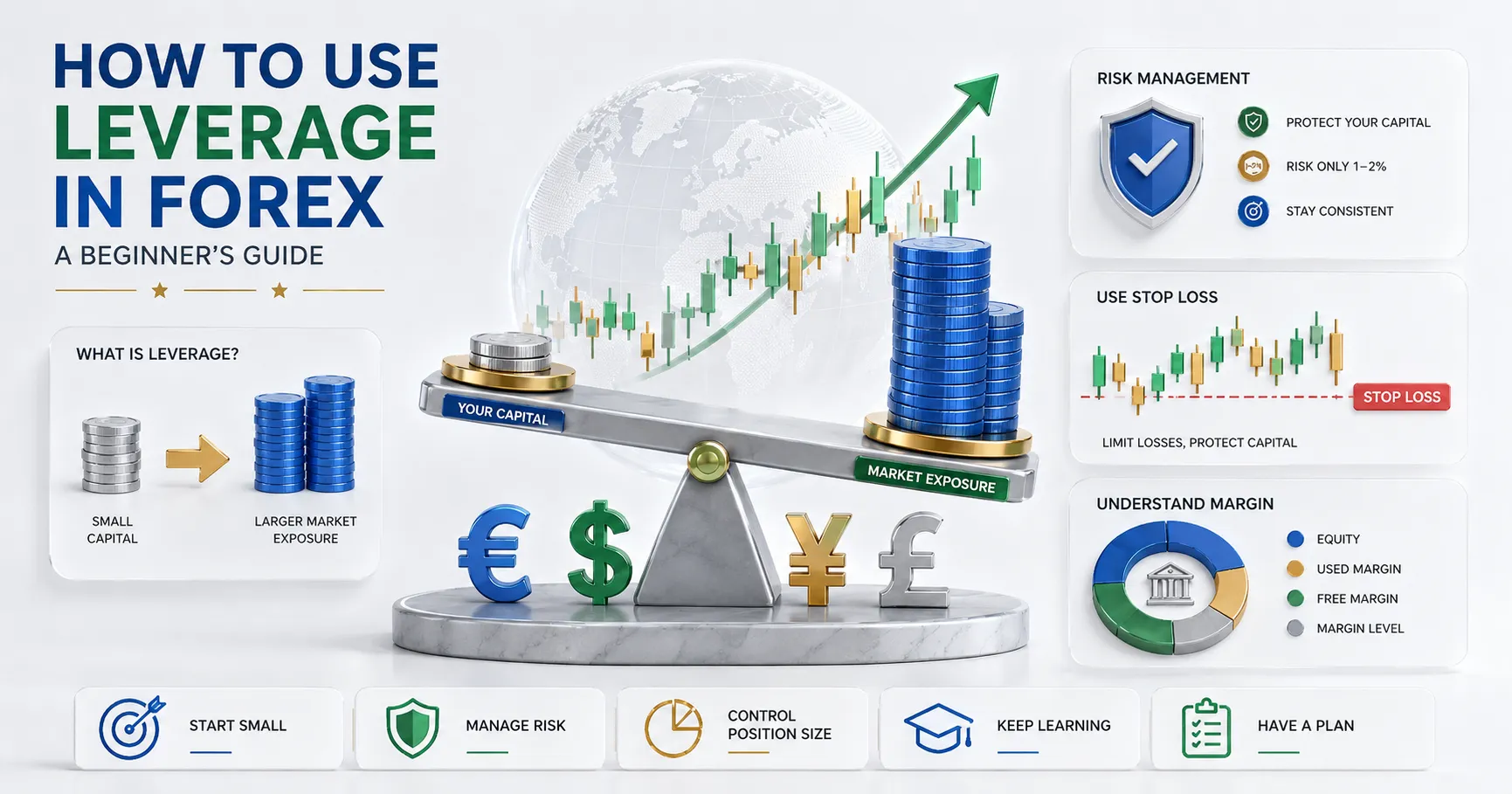
Leverage in forex allows you to control a position larger than your actual account balance. A 100:1 leverage ratio means $1,000 in your account can control $100,000 in a currency pair. This amplifies both gains and losses proportionally: a 1% move in your favor doubles your money; a 1% move against you wipes it out. This guide explains how forex leverage works mechanically, how to calculate its real impact, how regulated markets cap it, and how to use it without it using you.
What Leverage Actually Does
Without leverage, buying $100,000 of EUR/USD requires $100,000. With 100:1 leverage, the same position requires only $1,000 as margin. The broker effectively lends the remaining $99,000 for the duration of the trade. If EUR/USD moves 1% in your favor, you gain $1,000 on a $1,000 margin deposit, a 100% return. If EUR/USD moves 1% against you, you lose $1,000, 100% of the margin. Leverage does not change the probability of success; it changes the financial consequence of each pip of movement.
Key Leverage Concepts Defined
Margin: the deposit held by the broker to open and maintain a leveraged position. Not a fee; it is returned (minus any losses) when the trade closes. Used margin: the amount of your account currently locked as collateral for open positions. Free margin: account equity minus used margin; the amount available to open new positions or absorb losses. Margin call: a warning issued when your free margin falls below a threshold. You must deposit funds or close positions. Stop-out level: the equity level at which the broker automatically begins closing positions to prevent a negative balance, often set at 20-50% of margin.
Regulated Leverage Caps by Jurisdiction
| Regulator | Major Pairs | Minor/Exotic Pairs |
|---|---|---|
| CFTC/NFA (USA) | 50:1 | 20:1 |
| FCA (UK) | 30:1 | 20:1 (minors), 10:1 (exotics) |
| ESMA (EU) | 30:1 | 20:1 (minors), 10:1 (exotics) |
| ASIC (Australia) | 30:1 | 20:1 |
| Offshore (unregulated/lightly regulated) | Up to 500:1 or higher | Up to 500:1 or higher |
High leverage offered by offshore brokers (500:1, 1000:1) is frequently used as a marketing hook. A 500:1 leverage ratio means a 0.2% adverse price move eliminates the entire margin. EUR/USD moves 0.2% in minutes during active sessions.
How to Calculate Your Real Risk at Any Leverage Level
The correct process for determining position size is not “use the maximum available leverage.” It is: Step 1: decide your account risk per trade (1-2% of total equity). Example: $5,000 account, 1% risk = $50 maximum loss on this trade. Step 2: identify your stop-loss distance from chart structure. Example: stop-loss is 20 pips from entry. Step 3: calculate position size. On EUR/USD, 20 pips on a standard lot = $200 loss. To risk only $50, you need 0.25 lots. Step 4: verify the resulting margin requirement. The leverage ratio applied is a result of this process, not the starting point.
The Real Impact of Common Leverage Ratios
| Leverage Ratio | Adverse Move That Wipes Margin | EUR/USD Time to Reach This Move |
|---|---|---|
| 10:1 | 10% | Days to weeks |
| 30:1 | 3.3% | Hours to days |
| 100:1 | 1% | Minutes to hours |
| 500:1 | 0.2% | Seconds to minutes |
Negative Balance Protection
In many regulated jurisdictions (EU, UK, Australia), brokers are required to offer negative balance protection, ensuring that if a trade goes against you faster than a stop-out can execute, your account cannot go below zero. Without this protection, an extreme move can result in owing the broker money beyond your deposit. Verify whether your broker offers this before depositing, especially if trading with higher leverage.
Common Leverage Mistakes
Using maximum available leverage. The amount a broker permits and the amount appropriate for your risk tolerance are entirely different numbers. No stop-loss with high leverage. A leveraged position without a stop-loss is unlimited-risk exposure. Overleveraging after losses. Increasing leverage to recover losses faster is one of the most documented paths to total account loss. Misunderstanding free margin as safe to trade. Free margin is the buffer against losses on existing positions, not a pool of unallocated funds to open more positions freely.
Our Take
Leverage is a tool with a specific correct use: enabling appropriately sized positions with defined risk, not maximizing position size for the same capital. Used correctly, leverage makes forex accessible without requiring prohibitively large account sizes. Used incorrectly, it is the single fastest way to lose an account – a 100:1 leveraged position needs only a 1% adverse move to be completely wiped out.
The disciplined approach: determine position size from your risk percentage and stop-loss distance, use only the leverage that results from that calculation, and treat broker-maximum leverage as a ceiling that serious traders rarely need to approach.
This article is for informational and educational purposes only and does not constitute financial or trading advice. Forex trading with leverage carries significant risk of loss. Always conduct your own research and consult a qualified advisor.
Frequently Asked Questions
