How to Avoid Crypto Scams: A Complete Guide

- Crypto scam losses reached an estimated $9.9 billion globally in 2024, with romance scams (pig butchering) being the single largest category
- AI-generated deepfakes of public figures and executives are now a primary tool in investment scams; seeing a video of a known person endorsing a project is not verification
- Four categories cover most scams: fake investment platforms, romance/pig butchering scams, impersonation (fake exchanges, wallets, support), and phishing (fake websites, malicious links)
- Universal red flag: any promise of guaranteed returns or risk-free profits. No legitimate investment guarantees returns
- Legitimate platforms never DM you first, never ask for your seed phrase or private key, and never require you to send crypto before withdrawing profits
- Verification habit: always navigate directly to URLs rather than clicking links; confirm contract addresses from the protocol's official documentation, not social media
- If pressured to act quickly ("limited time offer," "your funds are at risk"), slow down - urgency is a manipulation tactic
- Crypto transactions are irreversible. Once sent to a scammer, funds cannot be recovered through any technical means
Crypto scams stole an estimated $9.9 billion globally in 2024, and 2025-2026 have seen the rise of AI-generated deepfakes, pig butchering operations, and impersonation attacks sophisticated enough to fool experienced investors. The good news: the patterns are repetitive and identifiable. This guide covers the most common scam types, the red flags that appear in nearly all of them, and the specific verification habits that protect against each category.
Why Crypto Attracts Scams
Three structural features make cryptocurrency a uniquely attractive target for fraud. Irreversibility: confirmed blockchain transactions cannot be reversed, disputed, or recalled. There is no chargeback mechanism. Pseudonymity: wallet addresses reveal nothing about their owner’s identity, making scammers very difficult to trace. Complexity and novelty: technical complexity and rapid pace of development creates information asymmetry that legitimate-sounding explanations can exploit.
The Five Most Common Scam Types in 2026
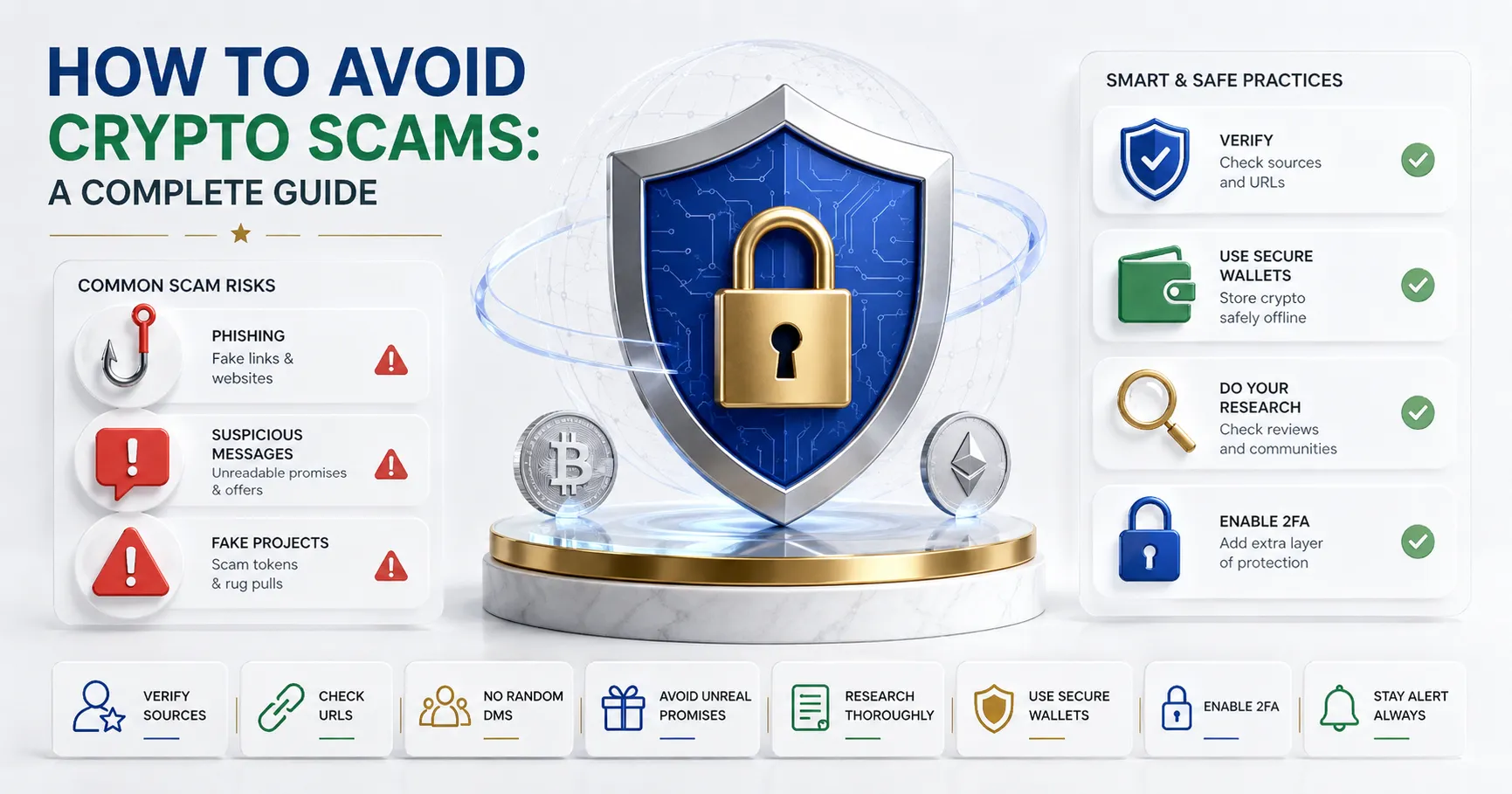
1. Pig Butchering (Romance Scams). The largest category by dollar loss. A scammer contacts the target on dating apps, social media, or even by “wrong number” text, builds a relationship over weeks or months, then introduces a “profitable” crypto trading platform. The victim deposits funds and watches apparent profits grow. When they try to withdraw, they are told to pay taxes, fees, or additional deposits. The platform is fake; all apparent profits are fabricated.
2. Fake Investment Platforms. Websites or apps that mimic legitimate crypto exchanges or trading platforms. The platform shows a convincing dashboard with climbing balances. Withdrawals either fail with invented fees or simply do not process. Signs of a fake platform: it does not appear on CoinGecko or CoinMarketCap, cannot be found in official app stores, its team cannot be independently verified, and it was registered very recently.
3. Impersonation and Support Scams. Scammers impersonate Coinbase, Binance, MetaMask, or other legitimate platforms in fake support emails, Twitter/X replies, Discord messages, or SMS alerts. The goal is always the same: extract the seed phrase or private key, or get the victim to send crypto to a “recovery wallet.” Legitimate crypto support never contacts users first. Legitimate support never asks for a seed phrase or private key under any circumstances.
4. Phishing. Fake websites that closely mimic legitimate platforms distributed via fake Google ads, email links, or social media DMs. When a user “connects” their wallet or enters their seed phrase on a phishing site, the attacker gains full access to the wallet.
5. Fake Tokens and Rug Pulls. A new token is launched with a credible website, whitepaper, and social media presence. Early buyers see the price rise. The developers then dump their holdings or drain the liquidity pool, crashing the price to zero.
| Scam Type | How It Works | Primary Red Flag |
|---|---|---|
| Pig butchering | Relationship built, fake trading platform introduced | Romantic/platonic contact who introduces an investment |
| Fake platform | Convincing but fictional exchange or trading dashboard | Not verifiable on CoinGecko, App Store, or official registries |
| Impersonation | Fake support asks for seed phrase or “verification transfer” | Any request for seed phrase or private key |
| Phishing | Fake website captures credentials or seed phrase | URL does not exactly match the official domain |
| Rug pull | New token, developers drain liquidity and exit | Anonymous team, unaudited contract, sudden hype growth |
AI Deepfakes: The New Dimension
2025-2026 has introduced AI-generated video deepfakes of Elon Musk, Vitalik Buterin, Changpeng Zhao, and other public figures appearing to promote specific investments, giveaways, or urgent buy signals. These videos are increasingly convincing and appear on YouTube channels, social media ads, and fake news sites. Seeing a video of a known person endorsing something is no longer verification. The only reliable verification is cross-referencing any claim on the person’s verified, official communication channels.
Universal Red Flags
Guaranteed returns. No legitimate investment guarantees profits. Pressure to act immediately. Urgency is a manipulation tactic designed to prevent verification. Unsolicited contact. Legitimate platforms do not DM users to offer investment opportunities. Requests for your seed phrase or private key. No legitimate service, ever, needs this information. Deposits required before withdrawals. Any platform requiring you to send more crypto before releasing existing balances is a scam. No independent verification possible. Legitimate exchanges appear on CoinGecko, CoinMarketCap, official app stores, and have verifiable regulatory registrations.
Verification Habits That Protect You
Type URLs directly; do not click links. Phishing attacks depend on links. Bookmark official sites immediately. Check contract addresses on the protocol’s official documentation. Always copy contract addresses from verified official sources, not social media or Telegram. Search the exchange name plus “scam” or “review” before depositing. Never take investment advice from someone you only know online. Regardless of how long a relationship has developed, romantic or platonic contacts who introduce investment opportunities are following a known scam pattern.
If You Suspect You Have Been Scammed
Do not send more money. The most common secondary scam is a “recovery service” that promises to retrieve stolen funds for an upfront fee. Document everything: screenshots of conversations, transaction IDs, wallet addresses, and website URLs. Report to relevant authorities: in the US, FBI IC3 at ic3.gov and FTC at reportfraud.ftc.gov. Understand that crypto transactions are irreversible. No authority, recovery service, or technical process can reverse a confirmed blockchain transaction.
Our Take
Crypto scams follow remarkably consistent patterns. The same red flags, guaranteed returns, urgent timelines, requests for seed phrases, required deposits before withdrawal, and unsolicited investment introductions from new online contacts, appear across virtually every category. Verification habits, typing URLs directly, cross-checking on official sources, never sharing seed phrases, and verifying any platform before depositing, protect against the vast majority of attack vectors.
The only fully irreversible aspect of a crypto scam is the transaction itself. That means prevention is the only remedy.
This article is for informational and educational purposes only. If you believe you have been a victim of fraud, report it to relevant law enforcement authorities in your jurisdiction.
Frequently Asked Questions
