Best Trading Hours for UAE Market Overlap 2026

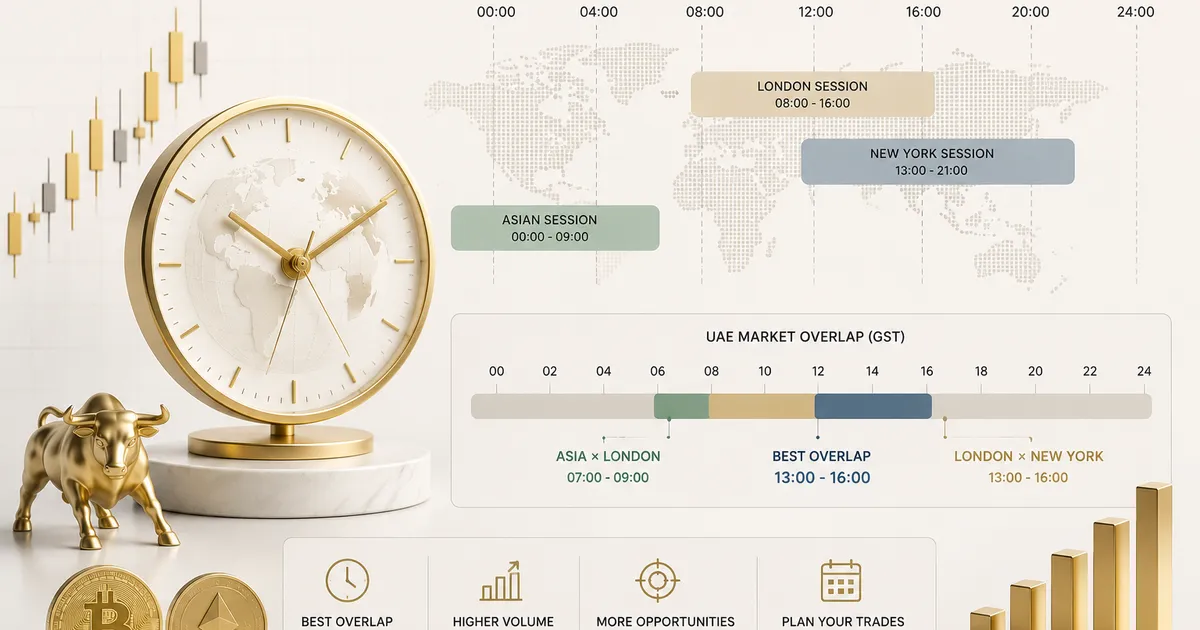
- The London-New York overlap is the most active trading window globally, falling between approximately 4:00 PM and 9:00 PM GST depending on the time of year
- The forex market opens for the UAE trading week with the Sydney session at approximately 1:00-2:00 AM GST on Monday
- The London session is the single largest session by trading volume, running from approximately 11:00 AM/12:00 PM to 8:00 PM GST
- The New York session opens around 4:00-5:00 PM GST and closes around 1:00-2:00 AM GST, with the exact times shifting due to US daylight saving changes
- More than 50% of global forex trading volume occurs during the London-New York overlap window
- The UAE does not observe daylight saving time, so all session overlap timings shift relative to GST as London and New York adjust their own clocks seasonally
- Crypto markets trade 24/7, but liquidity and volatility still tend to concentrate around the same major session overlaps that drive forex activity
- EUR/USD, GBP/USD and USD/JPY tend to be the most active pairs during the London-New York overlap
The best trading hours for UAE traders fall during the London-New York session overlap, which runs approximately from 4:00 PM to 8:00 PM Gulf Standard Time (GST) in UAE summer and shifts to roughly 5:00 PM to 9:00 PM GST during UAE winter, depending on daylight saving changes in London and New York. This four-hour window combines the world’s two largest financial centers trading simultaneously, producing the highest liquidity, tightest spreads, and most significant price movements of the trading day. This guide breaks down each global session in GST and explains why the overlap matters most for UAE-based forex and crypto traders.
Why Session Overlaps Matter for UAE Traders
Global currency markets operate continuously across four major trading centers: Sydney, Tokyo, London and New York. Each session corresponds to the business hours of major financial institutions in that region, and trading activity is driven by the banks, hedge funds and brokers active within each center at any given time.
Because these sessions overlap rather than running back-to-back with gaps, certain windows see two major financial centers trading simultaneously. During these overlaps, liquidity increases substantially, bid-ask spreads on major currency pairs tend to tighten, and the probability of significant price movement rises. For traders, this generally means better fill quality, lower transaction costs through tighter spreads, and more reliable price action compared with quieter, single-session periods.
The UAE’s position on Gulf Standard Time (GST, UTC+4) places it conveniently between the Asian and European/American trading days. This geographic advantage means UAE-based traders can access both the London and New York sessions during reasonably normal waking hours, without the late-night or pre-dawn discipline required in some other time zones.
At MarketsByte, we cover UAE and US financial markets daily, and one detail worth flagging directly: the UAE does not observe daylight saving time, while both London and New York do. This means every session’s GST equivalent shifts by an hour twice a year as the UK and US adjust their clocks, even though Dubai and Abu Dhabi’s local time never changes.
The Four Global Trading Sessions in GST
| Session | Approximate GST Hours | Key Characteristics |
|---|---|---|
| Sydney | 1:00 AM – 10:00 AM GST | Opens the trading week; lower volume than London/New York |
| Tokyo | 4:00 AM – 1:00 PM GST | Most active for yen pairs (USD/JPY, EUR/JPY, GBP/JPY) |
| London | 11:00 AM/12:00 PM – 8:00 PM GST | Largest session by volume; tightest spreads on majors |
| New York | 4:00-5:00 PM – 1:00-2:00 AM GST | USD-driven; Fed announcements and US data releases fall here |
Exact times shift by approximately one hour twice yearly due to UK/US daylight saving changes, since the UAE does not adjust its own clocks.
Sydney session. The trading week effectively begins for UAE traders when the Sydney session opens around 1:00-2:00 AM GST on Monday, depending on Australian daylight saving status. Volume tends to be comparatively modest, making this a quieter window relevant mainly for AUD and NZD pairs.
Tokyo session. Opening around 4:00 AM GST, the Tokyo session sees the highest activity in yen-related pairs such as USD/JPY, EUR/JPY and GBP/JPY. This session overlaps briefly with the tail end of Sydney trading and the early part of the London session.
London session. The London session is the largest and most liquid forex session by volume globally. Opening at approximately 11:00 AM GST in UK summer time or 12:00 PM GST in UK winter time, and closing around 8:00 PM GST, this session represents the majority of global forex volume transacted on any given day, with spreads on major pairs typically at their tightest throughout its duration.
New York session. Opening around 4:00 PM GST during US daylight saving time or 5:00 PM GST during US standard time, the New York session is where the US dollar, the world’s most heavily traded currency, drives the bulk of activity. US economic data releases, Federal Reserve communications and other dollar-sensitive news typically fall within this window.
The London-New York Overlap: UAE’s Prime Trading Window
The overlap between the London and New York sessions is widely regarded as the single most important trading window of the day, and it falls conveniently within UAE evening hours.
Depending on seasonal daylight saving adjustments in the UK and US, this overlap runs approximately from 4:00 PM to 8:00 PM GST (when both regions observe daylight saving time) or 5:00 PM to 9:00 PM GST (when both observe standard time). During the period when the two regions are on different daylight saving schedules, which happens for a few weeks each spring and autumn, the overlap window shifts by an additional hour temporarily.
During this four-hour window, trading volume reaches its daily peak. More than 50% of total global forex trading volume is estimated to occur during the combined activity of the London and New York centers, with the overlap period representing the most concentrated portion of that volume. Bid-ask spreads on major pairs, particularly EUR/USD, GBP/USD and USD/JPY, tend to be at their tightest, and the highest-impact price movements of the day, including reactions to major US data releases, typically occur within this window.
| Time of Year | Approximate Overlap (GST) | Reason for Variation |
|---|---|---|
| Both UK and US on daylight saving time | 4:00 PM – 8:00 PM GST | Both regions shift their local clocks forward |
| Both UK and US on standard time | 5:00 PM – 9:00 PM GST | Both regions on winter clock settings |
| Transition weeks (UK/US clocks misaligned) | Shifts by an additional hour temporarily | UK and US change clocks on different calendar dates |
For UAE-based traders, this window falls conveniently in the early evening rather than requiring overnight monitoring, which is a structural advantage compared with traders in time zones where this overlap falls during sleeping hours.
Which Pairs Are Most Active During the Overlap
Currency pairs tend to be most liquid when the financial centers relevant to their component currencies are simultaneously active. During the London-New York overlap specifically, pairs involving the US dollar and euro see the deepest liquidity.
EUR/USD is generally the most actively traded pair globally during this window, given that it directly represents the two largest economic blocs whose financial centers are both open simultaneously.
GBP/USD also sees concentrated activity, reflecting London’s role as the session host alongside New York’s dollar liquidity.
USD/JPY remains active throughout the overlap as well, though its peak activity window technically centers more around the Tokyo-London handoff earlier in the global trading day.
For UAE traders focused on major pairs, structuring trading activity around this specific four-hour window, rather than spreading attention evenly across the full 24-hour cycle, tends to align with when liquidity and price action are most favorable.
How Crypto Markets Relate to Session Overlaps
Cryptocurrency markets operate 24/7, without the fixed session structure that governs forex. There is no equivalent “market open” or “market close” for Bitcoin or Ethereum, since blockchain networks process transactions continuously regardless of traditional financial center hours.
That said, crypto trading volume and volatility are not perfectly uniform across the clock either. In practice, crypto liquidity often shows noticeable upticks during the same major session overlaps that drive forex activity, since many of the same institutional trading desks and liquidity providers active in forex during London-New York hours also participate in crypto markets. UAE-based crypto traders may still find the early evening window, broadly coinciding with the forex overlap, to be a period of relatively higher activity compared with the quieter hours overnight, though this pattern is less rigid and consistent than it is for forex.
For more on how to access regulated trading platforms for both digital assets and traditional markets from the UAE, see our guides on VARA-licensed crypto exchanges in UAE and low-spread forex brokers for UAE traders.
Who Should Prioritize the Overlap Window?
| Trader Profile | Relevance of the Overlap Window |
|---|---|
| Day traders and scalpers | High. Tighter spreads and stronger price moves directly benefit short-term strategies |
| Swing traders holding positions for days | Moderate. Entry/exit timing still benefits, but less critical than for short-term strategies |
| Long-term position traders | Lower. Session timing matters less when holding through multiple full trading cycles |
| News-driven traders (US data, Fed announcements) | High. Most major US economic releases fall within or near the New York session |
| Crypto traders | Moderate. Liquidity patterns loosely track the forex overlap but with less consistency |
Our Take
For UAE-based traders, the London-New York session overlap represents the most consistently favorable trading window of the day, combining peak liquidity, tighter spreads and the most significant price action into a roughly four-hour period that conveniently falls during early UAE evening hours. The exact GST timing shifts seasonally due to UK and US daylight saving changes, which UAE-based traders should track since the UAE itself does not adjust its clocks.
While forex trading benefits most directly from structuring activity around this overlap, crypto traders operating in a 24/7 market may still find loosely correlated upticks in liquidity during the same hours, reflecting shared institutional participation across both asset classes.
This article is for informational and educational purposes only and does not constitute financial advice. Trading forex and cryptocurrency carries risk of loss. Always conduct your own research and consult a qualified financial advisor before making trading decisions.
Frequently Asked Questions
