Order Block Trading: Mapping Order Blocks in Forex and Crypto


- An order block is the last bearish candle before a bullish impulse move, or the last bullish candle before a bearish impulse move, representing where institutions are believed to have placed large orders
- Order blocks differ from basic support and resistance because they point to a specific candle or small zone rather than a broad price area
- A valid order block is typically followed by displacement, a fast, decisive move that breaks market structure, not just a normal price bounce
- Order blocks work best when combined with other Smart Money Concepts: liquidity sweeps, stop hunts, fair value gaps, price imbalances, and break of structure or change of character signals
- Stop-losses are commonly placed just beyond the order block's low, for bullish setups, or high, for bearish setups, with a buffer of roughly 5-15 pips in forex
- When an order block fails and price trades decisively through it, it becomes a "breaker block," which can itself become a reference level for a new trade in the opposite direction
- Because order block identification is inherently subjective, two experienced traders can mark different zones on the same chart, which is the framework's most significant practical limitation
An order block is a price zone, specifically the last opposing candle before a strong, structure-breaking move, where institutional traders are believed to have placed large directional orders. Unlike a basic support or resistance zone that can span dozens of pips, an order block zooms in on the exact candle or micro-range where smart money dealt size. This guide explains how order blocks form, how to identify valid ones, and how they fit into the broader Smart Money Concepts (SMC) framework used across forex, crypto, and other liquid markets.
What Makes an Order Block Different from Support/Resistance
Order blocks and traditional support and resistance zones are related but distinct concepts. Support and demand zones can span dozens of pips on a chart. Order blocks zoom in much more precisely, focusing on the exact candle or micro-range where institutional activity is believed to have occurred, identified through specific price action and volume characteristics rather than simply “price bounced here before.”
The core idea: before a major directional move, institutions need to accumulate or distribute large positions without moving the market too far against themselves. They do this by staging entries into counter-trend flow, absorbing retail orders. The resulting candle, often the one that gets stopped out by retail traders before the real move begins, is the order block.
How to Identify a Valid Order Block
Step 1: Look for consolidation. A genuine order block typically forms after a period where price moved sideways in a relatively tight range, the phase where institutions are believed to build their position before a significant move.
Step 2: Spot the momentum candle. After consolidation, look for a candlestick noticeably larger than the preceding cluster, commonly cited as at least two to three times the size of recent candles. This oversized candle represents the moment institutional orders are filled aggressively.
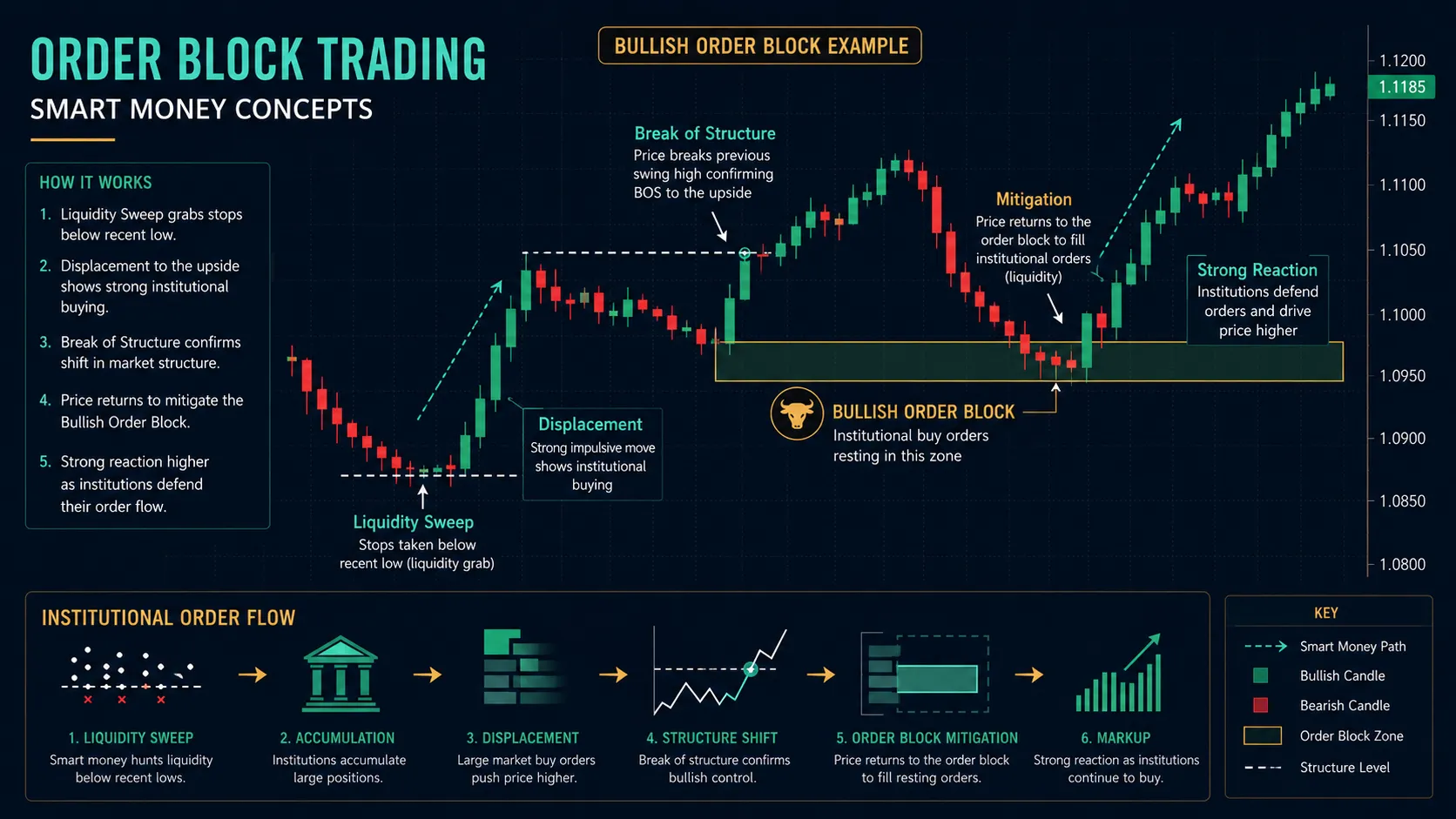
Step 3: Confirm displacement. A genuine order block is followed by a fast, one-sided move that breaks market structure, a recent swing high or low, not just a normal bounce. This structural break is often called Break of Structure, or BOS.
Step 4: Check for volume confirmation. A volume spike, commonly cited as 2x or higher than average surrounding candles, adds confidence that real institutional participation, not random noise, is behind the move.
Step 5: Look for a fair value gap. Price often leaves a small imbalance, a gap between candle wicks, right after the order block forms. This gap, called a fair value gap, or FVG, tends to get revisited later, and its presence adds credibility to the order block’s validity.
| Checklist Item | What to Confirm |
|---|---|
| Consolidation | Tight sideways range before the move |
| Momentum candle | Candle 2-3x larger than recent average |
| Displacement | Fast move that breaks recent structure (BOS) |
| Volume | Spike of 2x+ average surrounding candles |
| Fair value gap | Small price imbalance left behind by the impulse move |
Bullish vs. Bearish Order Blocks
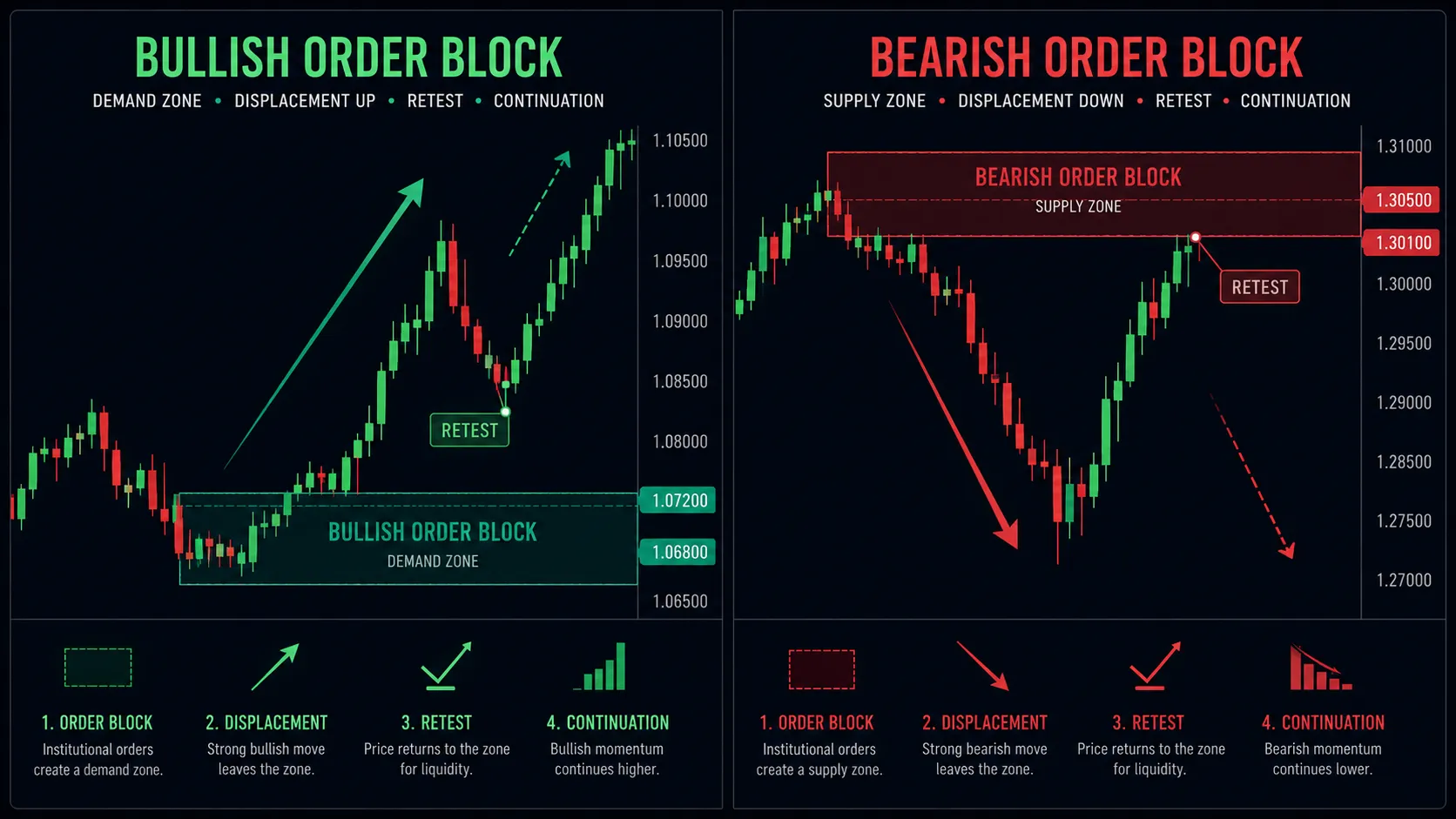
A bullish order block is the last bearish, down, candle before a strong bullish impulse move that breaks structure to the upside. When price later retraces back to this zone, traders look for a long entry, expecting institutional buying interest to reappear.
A bearish order block is the last bullish, up, candle before a strong bearish impulse move that breaks structure to the downside. It acts as a supply zone, where traders look for short entries on a retracement back into the zone.
Order Blocks in Forex vs. Crypto
Order block logic applies identically across forex, crypto spot, crypto perpetual futures, indices, and commodities, since the underlying premise, that large players need liquidity to fill big orders without moving the market too far against themselves, holds in any sufficiently liquid market.
In forex, order blocks are particularly relevant given the market’s extreme liquidity and trading volume, especially on major pairs like EUR/USD and GBP/USD, where institutional footprints are easier to distinguish from noise. Forex traders commonly map order blocks on the daily or 4-hour chart for directional context, then refine entries on the 15-minute or 5-minute chart.
In crypto, the same framework applies, with large-cap assets like BTC and ETH offering the clearest order flow signals given their deep liquidity relative to smaller altcoins. Crypto’s 24/7 trading and higher baseline volatility mean displacement moves can be sharper and faster than in forex, which some traders adjust for with slightly wider stop-loss buffers.
Breaker Blocks: When an Order Block Fails
When an order block fails, meaning price trades decisively through it rather than reversing as expected, it becomes known as a breaker block. This is a distinct but related concept: rather than marking where institutional activity first appeared, a breaker block reflects what happens when that activity no longer holds.
A bearish breaker block forms after a bullish order block fails, when a level expected to support the market’s rise instead gives way, suggesting sellers have overwhelmed buyers and sentiment has shifted bearish. A bullish breaker block forms after a bearish order block fails, suggesting the opposite shift.
Traders often use a breaker block as a new reference level for a trade in the direction the breach suggests, anticipating that price returning to retest the failed zone will now reject from it in the new direction, rather than reverting to the original expectation.
Risk Management for Order Block Trades
Stop-loss placement is typically set just beyond the order block’s distal line, below the low of a bullish order block, or above the high of a bearish order block, never inside the block itself, since price can sweep partially into the zone before reacting. A common buffer is roughly 5-15 pips in forex, or a few ticks in futures and indices, depending on the asset’s typical volatility.
Invalidation criteria beyond a simple stop-loss hit are also commonly used: if a candle closes beyond the order block’s midpoint, the 50% level, some traders consider the block “mitigated” and exit manually rather than waiting for the full stop-loss to trigger, reducing the loss on a failed setup.
Position sizing should follow the same general principle used across all trading styles: never risk more than 1-2% of total account capital on any single order block trade, regardless of how clean or high-confidence the setup appears.
The Honest Limitation: Subjectivity
The most significant practical limitation of order block trading is that identification is inherently subjective. Two experienced traders looking at the identical chart can mark completely different order blocks, fair value gaps, and liquidity zones. This is a meaningful issue because subjective frameworks are difficult to reliably backtest; without consistent, mathematically defined criteria for what counts as a valid order block, it’s hard to verify whether the approach carries a genuine statistical edge or simply feels intuitive after the fact.
Some traders address this by using algorithmic indicators that apply fixed, mathematical criteria for order block detection, allowing for actual backtesting and verifiable performance metrics, though even these tools require interpretation about which detected zones are worth acting on.
Who Should Use Order Block Trading?
| Trader Profile | Fit for Order Block Trading |
|---|---|
| Traders comfortable with price-action-based discretionary analysis | Strong fit |
| Traders wanting fully systematic, backtestable rules | Weaker fit unless using algorithmic SMC tools with fixed criteria |
| Traders on liquid major pairs, large-cap crypto, or major indices | Strong fit; institutional footprints are clearer in deep liquidity |
| Traders on thin, illiquid, or highly manipulated small-cap assets | Weaker fit; harder to distinguish genuine institutional activity from noise |
Our Take
Order block trading offers a more precise, institutionally-focused alternative to broad support and resistance zones, mapping the specific candles believed to represent large directional positioning before a structural break. The framework applies consistently across forex, crypto, and other liquid markets, and works best when combined with complementary Smart Money Concepts like liquidity sweeps, fair value gaps, and structure-break confirmation rather than used in isolation.
The most important caveat is honesty about subjectivity: order block identification varies meaningfully between traders, which means disciplined risk management, never risking more than a small, fixed percentage per trade, matters just as much as getting the zone identification itself right.
This article is for informational and educational purposes only and does not constitute financial advice. Trading carries risk of loss. Always do your own research before trading with real capital.
Frequently Asked Questions
