How to Start Investing in Dubai: A Complete Guide


- Dubai imposes zero personal income tax and zero capital gains tax on individual investment returns across property, stocks, and most financial instruments
- Four main investment categories accessible to foreigners: real estate (freehold zones), stocks (DFM via NIN), business establishment (free zone or mainland), and financial products (licensed brokers and DIFC platforms)
- A UAE Golden Visa is available to investors placing AED 2M+ in qualifying Dubai property or business - providing 10-year residency rights alongside the investment return
- The AED-USD peg at 3.6725 (stable since 1997) eliminates currency risk for USD-denominated investors across all Dubai investment categories
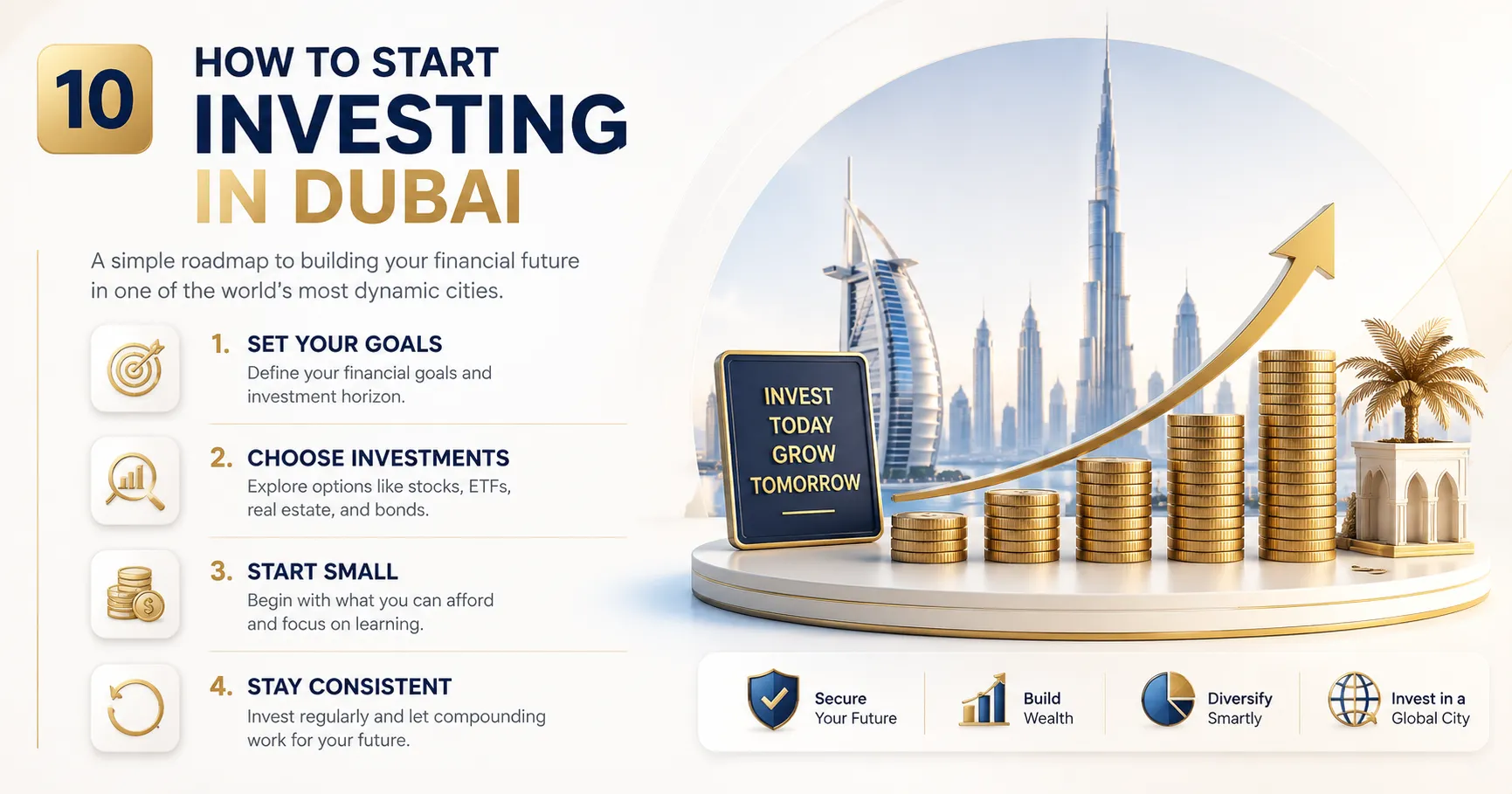
Dubai offers one of the world’s most accessible investment environments for both residents and foreign nationals: zero personal capital gains tax, zero income tax on investment returns, 100% foreign business ownership, and multiple asset classes available for international participation. Whether your interest is property, stocks, business ownership, or financial instruments, this guide maps the practical entry path for each investment category and explains the Dubai-specific details that make the process different from investing in London, New York, or Singapore.
Why Investors Choose Dubai
Zero personal tax: no capital gains tax, no income tax on dividends or investment returns, no wealth tax, no estate tax for individual investors. Currency stability: AED has been pegged to USD at 3.6725 since 1997; USD investors face no exchange rate risk on Dubai investments. Strategic geography: Dubai sits at the intersection of Europe, Asia, and Africa, within 8 hours’ flight of two-thirds of the world’s population. Transparent legal framework: property registration at the Dubai Land Department (DLD), company licensing at DMCC, DIFC, and DED, and securities regulation by the CMA and DFSA provide clear legal ownership and dispute resolution frameworks. Residency linkage: investment thresholds trigger visa eligibility; property investors with AED 2M+ can access 10-year Golden Visa residency without an employer sponsor.
Investment Category 1: Real Estate
Dubai’s real estate market offers gross rental yields of 6-10% in popular residential areas and freehold ownership is available to all nationalities in designated zones. How to invest: select a property in a freehold zone (Dubai Marina, Downtown, Palm Jumeirah, JVC, Business Bay, and others), sign a Memorandum of Understanding (MOU) with a 10% deposit, complete due diligence and financing (UAE mortgage available up to 75% LTV for non-residents on properties below AED 5M), complete at a DLD-registered trustee office where title transfers simultaneously with full payment, then register with DLD. Transaction costs are 4% DLD transfer fee plus agent commission (typically 2%) plus minor registration fees. Budget 6-7% above purchase price for all-in acquisition costs. Tax: zero capital gains tax on sale, zero property tax annually, zero tax on rental income for individual investors. Golden Visa: AED 2M+ property qualifies for 10-year renewable UAE Golden Visa.
Investment Category 2: Dubai Stock Market (DFM)
The Dubai Financial Market lists equities across banking, real estate, telecom, and services sectors. All investors require a free National Investor Number (NIN) before trading. How to invest: obtain NIN (free, digital application via DFM app or through a broker), open an account with a CMA-licensed broker, fund the account via bank transfer, trade during the DFM session (Sunday-Thursday, 10:00 AM-2:00 PM UAE time), and trades settle T+2. Tax: zero capital gains tax, zero tax on dividends for individual investors. Key listed companies include Emaar Properties, Emirates NBD, Dubai Islamic Bank, Air Arabia, and Emirates REIT.
Investment Category 3: Business Investment
Free zone establishment: 100% foreign ownership, zero personal income tax, full profit repatriation, streamlined licensing in 1-5 days for many activities. Primary limitation: cannot trade directly with UAE mainland customers without a local distributor or separate mainland license. Major free zones: DMCC (commodities, crypto), DIFC (finance, law), Dubai Internet City (technology), Dubai Media City (media), JAFZA (logistics). Mainland company formation (LLC): allows direct trading with UAE mainland market; since the 2021 Commercial Companies Law amendment, 100% foreign ownership is now permitted in most sectors. Investment threshold for Golden Visa (business route): AED 2M+ invested in a UAE-licensed business qualifies for the investor Golden Visa.
Investment Category 4: Financial Products and Platforms
DIFC-based investment platforms: several globally recognized wealth management firms and brokerage platforms are DIFC-licensed with DFSA regulatory oversight, offering access to equities, bonds, alternatives, and structured products. UAE bonds and sukuk: issued by UAE government entities and corporations, available through NASDAQ Dubai and secondary markets. Robo-advisors and digital wealth platforms: StashAway, Sarwa, and Wahed Invest are regulated UAE platforms offering automated portfolio management from low minimum investments.
Tax Considerations in Dubai
| Tax Type | Rate for Individuals |
|---|---|
| Personal income tax | 0% |
| Capital gains tax (property, stocks) | 0% |
| Dividend tax | 0% |
| Rental income tax | 0% |
| Annual property tax | 0% |
| VAT (on goods and services) | 5% (applied to consumption, not investment returns) |
| Corporate tax (businesses) | 9% above AED 375,000 (0% for QFZPs) |
Note for expats: UAE tax treatment does not cancel home-country obligations. US citizens remain taxable by the IRS on worldwide income regardless of UAE residency. Consult an international tax advisor before making residency-linked investment decisions.
Our Take
Dubai offers a genuine, comprehensive investment environment for foreign nationals: tax-free returns across property, equities, and business investment; full currency stability against the USD; accessible legal ownership frameworks; and residency incentives through the Golden Visa that make long-term commitment attractive rather than merely tolerated. The four investment categories – real estate, stocks, business, and financial products – each have distinct entry requirements but all share the same foundational advantages that make Dubai one of the world’s most compelling destinations for globally mobile capital.
This article is for informational and educational purposes only and does not constitute financial, legal, or investment advice. Always conduct your own research and consult qualified local advisors before investing.
Frequently Asked Questions
