UAE Economic Growth Opportunities: Market Trends 2026


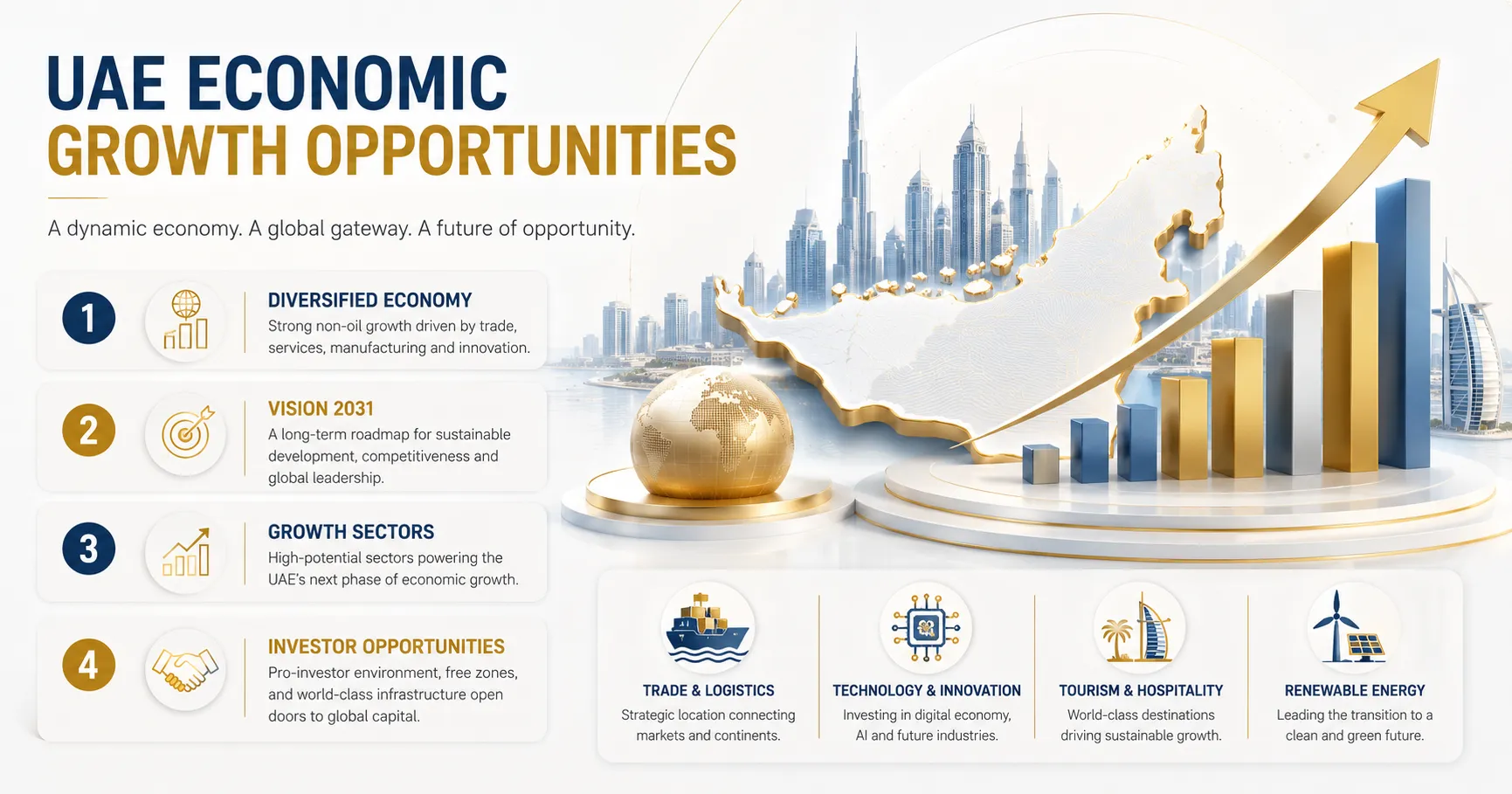
- UAE GDP grew at approximately 4-4.5% in 2024-2025, outperforming most G20 economies, driven by non-oil sectors including trade, tourism, finance, and real estate
- Non-oil GDP now represents over 70% of total UAE economic output - the diversification strategy (Vision 2030 and CBUAE 2026 roadmap) is measurably working
- Dubai ranked among the world's top 5 cities for real estate investment in 2024-2025 (Knight Frank); Abu Dhabi's sovereign wealth holds estimated $1.7T+ in assets
- UAE has become the world's third-largest crypto hub by regulatory activity and licensed entities, behind only the US and Singapore
The UAE is executing one of the most deliberate economic transformations of any country its size: diversifying from oil dependence toward finance, technology, tourism, logistics, and digital assets. For investors and entrepreneurs, this transition creates sector-specific opportunities that are visible in government policy, infrastructure investment, and capital flows. This guide covers the UAE’s current macro position, the sectors attracting the most capital, and what the economic trajectory looks like through the mid-2020s.
Macro Context: Where the UAE Economy Stands
The UAE is a confederation of seven emirates, with Dubai and Abu Dhabi driving the overwhelming majority of economic activity. UAE nominal GDP sits approximately USD 500-530 billion in 2025, with real GDP growth at approximately 4-4.5%, substantially above the US, EU, and UK growth rates in the same period. The IMF projects the UAE to sustain 4%+ growth through 2026-2027 backed by strong non-oil sector expansion. Non-oil GDP now represents over 70% of total UAE economic output. UAE population is approximately 10 million, with over 88% being foreign nationals. The AED has been pegged to the USD at 3.6725 since 1997.
Sector 1: Financial Services and Capital Markets
DIFC (Dubai International Financial Centre) reported record company registrations in 2024-2025, with over 6,000 active registered companies including global banks, asset managers, law firms, and fintech startups. Abu Dhabi Global Market (ADGM) has similarly grown as a financial and fintech hub, with a particular focus on asset management and wealth management firms. Financial services infrastructure including fund administration, custody, compliance technology, and cross-border payment solutions are in active development demand.
Sector 2: Digital Assets and Crypto
VARA (Virtual Assets Regulatory Authority), established in 2022, provides a clear licensing framework for crypto exchanges, custodians, brokers, and investment advisors operating in Dubai. By 2026, major exchanges including Binance, OKX, and Bybit hold UAE licenses. DMCC’s Crypto Centre hosts 650+ blockchain companies. Regulatory clarity and institutional infrastructure make the UAE one of the most viable jurisdictions for launching crypto businesses or deploying capital into digital asset ventures with a credible legal framework.
Sector 3: Real Estate and PropTech
Dubai real estate has been among the strongest performing major property markets since 2021, driven by population growth from inbound migration and high rental yields attracting investors. Sub-sectors showing growth include luxury residential (Palm Jumeirah, DIFC, Downtown), mid-market residential (JVC, Dubai South, Dubai Creek Harbour) with rental yields of 8-10%, data centers and digital infrastructure, and PropTech including digital transaction platforms and fractional ownership.
Sector 4: Tourism and Hospitality
Dubai attracted 17+ million overnight visitors in 2024 (DTCM data). Tourism contribution to Dubai GDP exceeds 11% and is growing. Growth drivers include expansion of Dubai’s entertainment offering (Universal Studios Dubai, expected opening 2026), medical tourism, sports tourism (Formula 1, golf, cricket, tennis), and luxury cruise terminal expansion at Port Rashid and Mina Rashid.
Sector 5: Logistics and Supply Chain
UAE sits at the intersection of Europe, Asia, and Africa, with Jebel Ali Port (the busiest container port in the Middle East) and Dubai International Airport (the world’s busiest for international passengers). DP World is a global logistics operator headquartered in Dubai and one of the world’s largest port operators. E-commerce growth is driving demand for last-mile delivery infrastructure, cold chain logistics, and regional distribution centers serving the GCC’s 57 million consumers.
Sector 6: Technology and AI
The UAE AI Strategy 2031 targets making AI a fundamental component of government service delivery. MGX (UAE’s AI and advanced technology investment vehicle) has a mandate to invest in global AI leaders. G42 (Abu Dhabi AI company) partnerships include Microsoft ($1.5B announced 2024). GITEX Global (world’s largest tech event, hosted annually in Dubai) cements UAE as a tech events and networking hub. Opportunities include AI infrastructure, data centers, cybersecurity, and tech services targeting the GCC government and enterprise market.
Risks to UAE Economic Growth
Oil price dependency (residual): despite diversification, Abu Dhabi’s fiscal position remains linked to oil revenue. Geopolitical risk: UAE’s position as a regional hub depends on Gulf stability; escalation in Iran-related tensions or Strait of Hormuz disruption would affect trade flows and investor sentiment. Population dependency on policy: 88% of the population being foreign nationals means economic activity is sensitive to visa, labor, and business policy changes. Global liquidity: UAE real estate and capital markets are meaningfully connected to global liquidity cycles.
Our Take
The UAE economy in 2026 is one of the world’s most intentional growth stories: deliberate diversification from oil, targeted attraction of global capital and talent, and infrastructure investment that creates compounding advantages in finance, technology, logistics, and digital assets. The sectors with the clearest momentum – digital assets, AI infrastructure, luxury tourism, and real estate – are all experiencing genuine structural growth, not just cyclical bounce.
This article is for informational and educational purposes only and does not constitute financial or investment advice. All investments carry risk. Always conduct your own research and consult qualified advisors.
Frequently Asked Questions
