What Is a Crypto Presale? How to Evaluate and Avoid Traps


- A crypto presale is a private or semi-public token sale before exchange listing, usually at a discount to the anticipated launch price
- Stages typically run: private sale (VCs, angels) ��� presale (whitelist retail) ��� public sale (ICO/IDO) ��� exchange listing
- Common discount structures: 20-50% below expected listing price, with vesting periods locking tokens for weeks or months after listing
- Vesting schedules exist to prevent immediate dumping by presale participants; understand the unlock timeline before investing
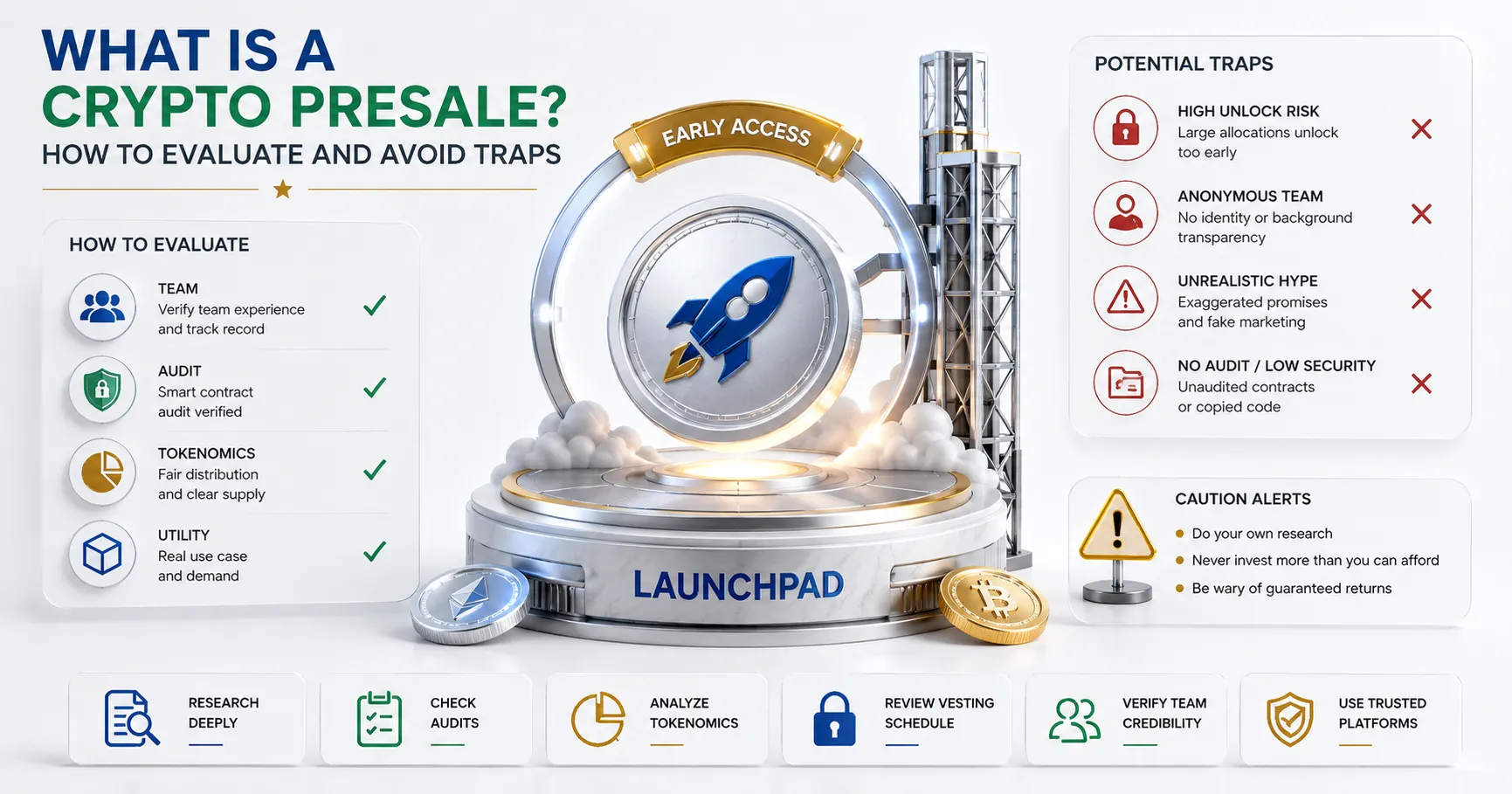
- Due diligence must cover: team identity and track record, smart contract audits, tokenomics (total supply, team allocation, unlock schedule), and whether the project actually has a working product
- Red flags: anonymous team with no verifiable history, no smart contract audit, no clear use case, unrealistic ROI promises, heavy social media hype with no substance
- Most presale projects fail or significantly underperform at listing; position sizing must reflect this reality
- Regulatory status of presale tokens varies by jurisdiction; many countries treat them as securities requiring specific disclosures
A crypto presale is an early-stage token sale that takes place before a project lists on a public exchange. Investors buy tokens at a discounted price in exchange for providing early capital to the project. Presales offer genuine asymmetric upside when a project succeeds, but they also carry some of the highest failure rates and fraud rates in all of crypto. This guide explains how presales work, what to look for, what to avoid, and how to size a presale position responsibly.
How Crypto Presales Work
A crypto presale typically occurs in distinct fundraising rounds before a token reaches open market trading. Private sale: the earliest round, restricted to venture capital firms, angel investors, and strategic partners. Tokens sold at the deepest discount with the longest vesting periods; retail investors rarely have access. Presale (whitelist sale): a semi-public round where selected retail investors can buy tokens at a preferential price. Public sale/IDO: the final pre-listing round open to the general public. Exchange listing: the token begins trading; presale investors can first sell their tokens subject to any vesting lock-up.
| Stage | Who Participates | Typical Discount | Typical Vesting |
|---|---|---|---|
| Private sale | VCs, angels, strategic partners | 40-70% below listing | 6-24 months |
| Presale | Whitelisted retail investors | 20-50% below listing | 1-12 months |
| Public sale/IDO | General public | 10-30% below listing | Days to months |
| Exchange listing | All market participants | None (market price) | None |
Understanding Vesting Schedules
Vesting schedules determine when presale investors can access and sell their tokens. A typical structure might lock 100% of tokens at listing, then release 10% per month over the following ten months. Before investing, map the full vesting schedule: what percentage unlocks at listing, the monthly unlock rate, when private sale and team tokens unlock (these can create significant sell pressure), and what the total circulating supply is at listing vs. the fully diluted valuation.
Tokenomics: What to Check
Key questions: what percentage of total supply goes to the team and advisors (more than 20-25% raises concentration risk); what is the team’s vesting schedule (short vesting periods are a warning sign); what percentage goes to treasury, ecosystem development, and community; is the total supply fixed or inflationary; what utility does the token actually have within the ecosystem.
Due Diligence Checklist
Team: can you verify the identities and track records of the founding team through LinkedIn profiles, GitHub activity, and prior project histories? Anonymous teams are a significant risk factor. Smart contract audit: has the token contract been audited by a reputable third-party firm (CertiK, Trail of Bits, OpenZeppelin, Quantstamp)? Is the audit report publicly available? Whitepaper quality: does the whitepaper describe a specific, coherent technical or business problem? Generic whitepapers full of buzzwords but light on specifics are a red flag. Working product: does a minimum viable product, testnet, or prototype exist? Community and transparency: does the team communicate regularly on official channels?
Red Flags That Signal a Scam or Likely Failure
Anonymous team with no verifiable history. No smart contract audit, or audit shows unresolved critical issues. Unrealistic return promises (“100x guaranteed at listing”). Heavy influencer marketing with no substance behind it. Token utility that exists only to justify the token. Very short vesting for the team relative to presale investors. No roadmap, or a roadmap with only vague milestones. Short or absent liquidity lock. Presale price that makes no mathematical sense relative to the claimed fully diluted valuation.
Sizing a Presale Position Responsibly
The historical failure rate of presale projects is high. Many never reach listing; many more list and then trend to zero as unlock schedules release large amounts of supply into a falling market. A common framework: allocate no more than 1-5% of a crypto portfolio to presales in aggregate, diversified across multiple projects rather than concentrated in one. Even within that allocation, assume any individual presale may return zero.
Regulatory Considerations
Many presale tokens may qualify as securities under applicable law, particularly in the United States, depending on the Howey Test criteria. The regulatory treatment of token presales continues to evolve; reviewing the project’s legal structure and checking its terms of service for your country is advisable before investing significant capital.
Our Take
Crypto presales offer genuine early-entry upside when projects succeed, but they carry some of the highest risk and fraud rates in the asset class. The due diligence framework is straightforward: verify the team, check the audit, understand the tokenomics, assess whether a working product exists, and size the position to reflect a realistic probability of total loss. Projects that cannot satisfy basic transparency requirements on these points should be passed regardless of how compelling the pitch sounds.
This article is for informational and educational purposes only and does not constitute financial advice. Crypto presale investments carry extremely high risk including total loss of capital. Always conduct your own research and consult a qualified financial advisor.
Frequently Asked Questions
