What Is DeFi and How Does It Work?


- DeFi = financial services (lending, borrowing, trading, yield) on public blockchains with no bank or broker in the middle
- Operates through smart contracts: code that executes automatically when conditions are met, removing the need for a human intermediary
- Ethereum holds approximately 75% of total value locked (TVL) across DeFi as of 2026, making it the dominant DeFi network
- Core services: decentralized exchanges (DEXs), lending and borrowing protocols, yield farming, stablecoins, and liquid staking
- Non-custodial: in most DeFi protocols, only you control your private keys and therefore your funds - but losing your keys means losing your assets permanently
- Major risks include smart contract vulnerabilities, liquidity risk, impermanent loss, oracle manipulation, and regulatory uncertainty
- Total value locked (TVL) across DeFi has grown significantly since 2020; DeFiLlama is the standard aggregator for tracking TVL across protocols and chains
- DeFi is not protected by FDIC insurance, consumer protection laws, or any equivalent regulatory framework in most jurisdictions
DeFi, or Decentralized Finance, refers to financial services built on public blockchains that operate without banks, brokerages, or any central intermediary. Lending, borrowing, trading, earning yield, and holding stablecoins can all happen through smart contracts, self-executing programs on networks like Ethereum, available to anyone with a crypto wallet and internet connection. This guide explains how DeFi works, the key protocols and services it includes, the real risks involved, and what beginners need to know before using it.
The Core Concept: Removing the Middleman
Traditional finance requires intermediaries at every step. A savings account needs a bank. Buying stocks requires a broker. Borrowing money requires a lender. Each intermediary takes a fee, operates on limited hours, requires identity verification, and can deny service. DeFi replaces these intermediaries with smart contracts: code deployed on a blockchain that executes automatically when predefined conditions are met, 24 hours a day, accessible to any address on the network.
How Smart Contracts Work
A smart contract is deployed to the blockchain and cannot be modified once live (unless specifically coded to be upgradeable). When a user interacts with it, their transaction is validated and executed transparently. The code is publicly auditable by anyone. Example: a lending protocol’s smart contract automatically accepts collateral, calculates how much a user can borrow based on the collateral ratio, and liquidates the position automatically if collateral value falls below a threshold, all without a human loan officer. This transparency and automation is DeFi’s core value proposition. It is also the source of its primary risks: bugs in smart contracts cannot be reversed, and there is no customer service to call.
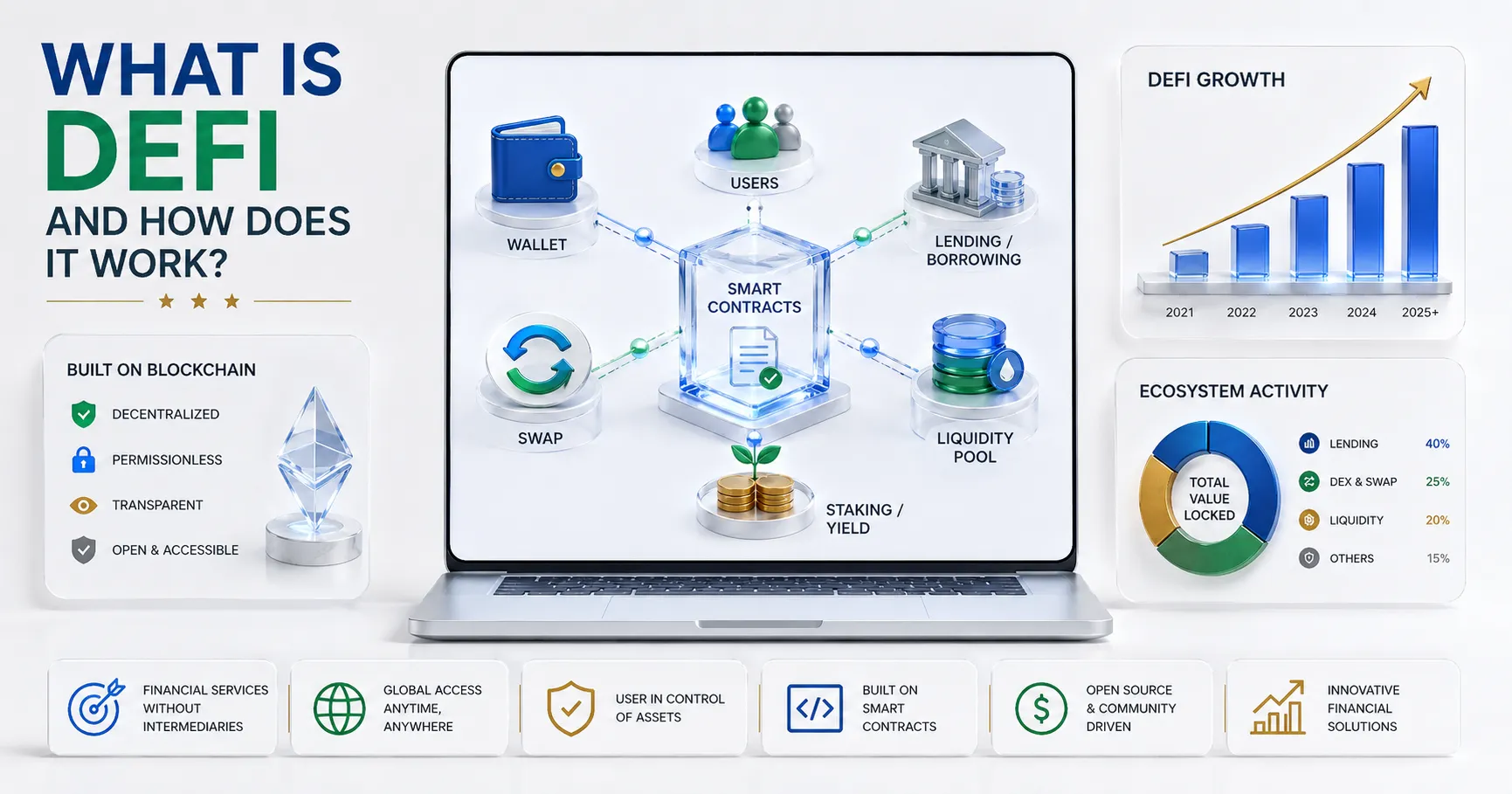
The Five Core DeFi Services
1. Decentralized Exchanges (DEXs). DEXs allow token trading directly from a wallet using liquidity pools rather than a traditional order book. Liquidity providers deposit token pairs into pools and earn a share of trading fees. Uniswap, Curve, and Balancer are among the most established DEXs.
2. Lending and Borrowing. Protocols like Aave and Compound allow users to deposit crypto assets as collateral and borrow other assets against them, or to supply assets and earn interest from borrowers. Interest rates adjust algorithmically. No credit check is required, but positions are overcollateralized, typically at 150% or higher.
3. Yield Farming and Liquidity Mining. Users deposit assets into protocols and earn yield through trading fees, protocol token rewards, or interest. Returns can be very high but carry commensurate risks.
4. Stablecoins. DeFi relies heavily on stablecoins, primarily USDC, USDT, and DAI, to provide price-stable assets. Algorithmic stablecoins, which maintain their peg through code rather than collateral, have demonstrated significant failure modes, including the collapse of TerraUSD in 2022.
5. Liquid Staking. Protocols such as Lido allow users to stake ETH and receive a liquid token (stETH) representing their staked position, which can then be used in other DeFi protocols simultaneously.
| DeFi Category | What It Does | Key Protocols |
|---|---|---|
| Decentralized exchange | Token swapping via liquidity pools | Uniswap, Curve, Balancer |
| Lending/borrowing | Deposit collateral, borrow assets | Aave, Compound, MakerDAO |
| Yield farming | Earn yield on deposited assets | Convex, Yearn Finance |
| Stablecoins | Price-stable crypto assets | USDC, DAI, USDT |
| Liquid staking | Stake assets while maintaining liquidity | Lido, Rocket Pool |
The Role of Ethereum and Other Networks
Ethereum dominates DeFi, holding approximately 75% of total value locked across protocols, because it was the first programmable blockchain with sufficient security and developer adoption to host financial applications at scale. Other networks have captured meaningful activity by offering faster transactions and lower fees: Solana, Arbitrum, Base (Coinbase’s Layer 2), Polygon, and Avalanche each host significant DeFi ecosystems. Cross-chain bridges allow assets to move between networks, though they have also been the site of some of DeFi’s largest hacks.
Real Risks Every DeFi User Must Understand
Smart contract risk. Bugs in smart contracts have led to hundreds of millions of dollars in losses. Even audited protocols have been exploited. Impermanent loss. Liquidity providers in DEX pools can suffer impermanent loss when the relative price of the two assets diverges significantly. Oracle manipulation. DeFi protocols rely on price oracles that tell smart contracts what assets are worth; flash loan attacks have been used to manipulate these. Rug pulls and exit scams. In newer protocols, developers may retain the ability to drain funds. No recourse. Unlike a bank account, DeFi funds are not insured. Regulatory uncertainty. DeFi’s regulatory status remains actively debated globally.
How to Start Using DeFi Safely
Step 1: Get a non-custodial wallet. MetaMask is the most widely used. Write down your seed phrase and store it securely offline. Step 2: Fund the wallet with ETH or the native token of your target network for gas fees. Step 3: Start with established protocols only. Aave, Uniswap, Curve, Lido, and Compound have years of track records, large TVL, and multiple independent audits. Step 4: Use only what you can afford to lose. Step 5: Verify contract addresses independently from the official protocol documentation or CoinGecko, never from social media links or Discord DMs.
Our Take
DeFi replaces traditional financial intermediaries with smart contracts on public blockchains, enabling lending, borrowing, trading, and yield generation that is accessible to anyone with a crypto wallet. Its core value is openness, transparency, and permissionless access. Its core risk is the absence of safety nets: no deposit insurance, no consumer protection, no recourse if something goes wrong.
For beginners, starting with established, audited protocols, using small amounts initially, and understanding the specific risks of each protocol before depositing are the minimum responsible practices. DeFi’s potential is real; so is the loss risk.
This article is for informational and educational purposes only and does not constitute financial advice. DeFi participation carries significant risk of loss, including total loss of deposited funds. Always conduct your own research.
Frequently Asked Questions
