How Interest Rates Shape Forex and Gold Markets

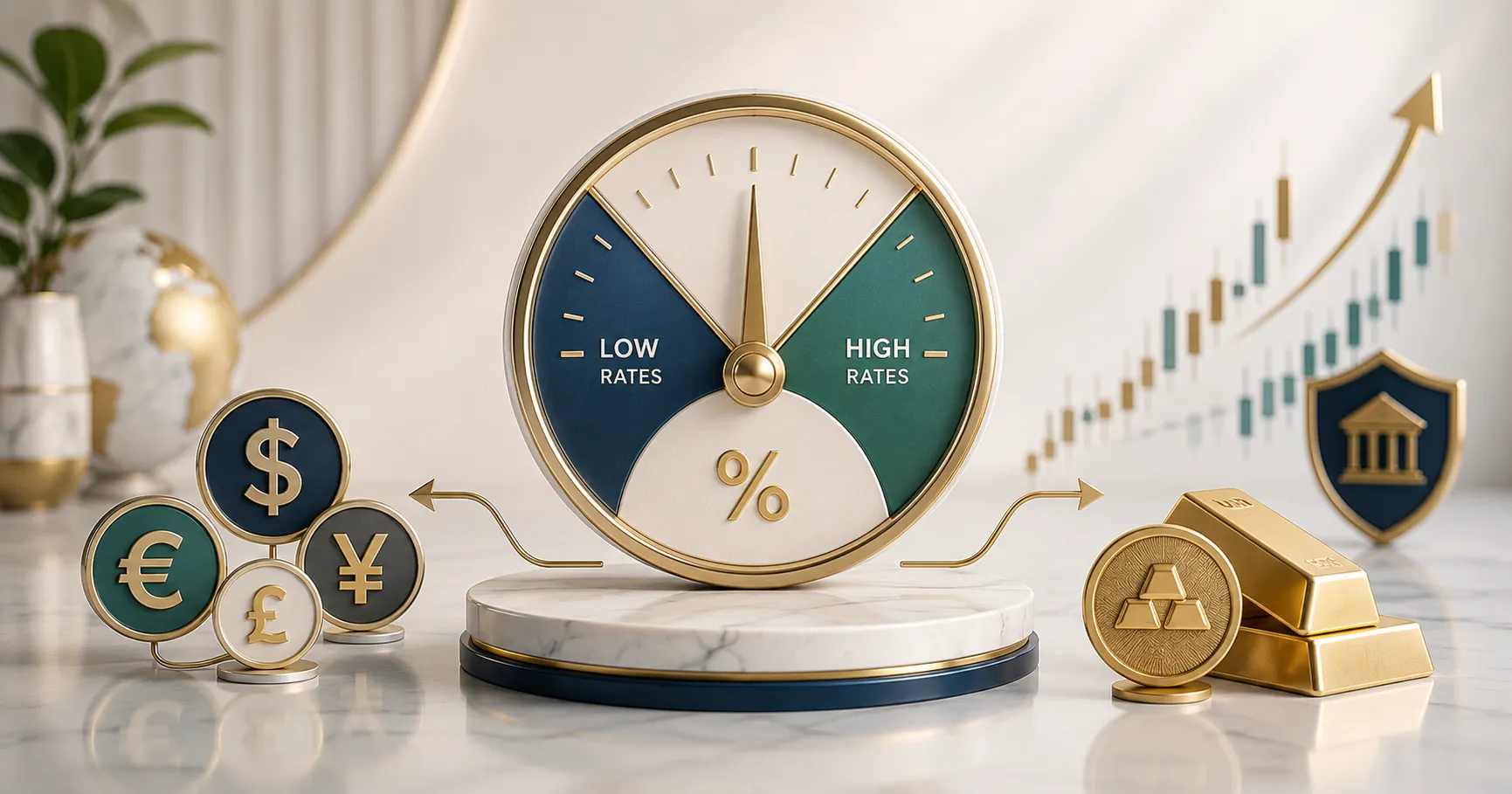
- Interest rate differentials between countries are the primary fundamental driver of currency pairs - capital flows to where the yield is higher, strengthening that currency
- Gold has an inverse relationship with real (inflation-adjusted) interest rates - rising real rates suppress gold; falling real rates support it
- The forex and gold markets react to rate expectations before decisions, meaning the "buy the rumor, sell the news" dynamic is extremely common around central bank announcements
- In the current 2026 cycle, the Fed's rate path is the dominant macro variable for both markets - with the AED-USD peg meaning UAE traders are especially exposed to USD dynamics
Interest rates are the most powerful macro variable in finance. When the Federal Reserve changes its benchmark rate, or even signals it might, currency pairs move, gold reprices, and bond yields adjust within seconds. Understanding the transmission mechanism, how a rate decision in Washington flows through to EUR/USD spreads and gold spot prices, is essential macro knowledge for any trader operating in forex or precious metals.
The Mechanism: How Rates Move Currencies
Currencies represent the relative attractiveness of holding assets in one country versus another. When a country raises interest rates, its bonds and savings accounts pay more. Foreign capital flows in to capture this higher yield, buying the currency to invest in it, and the currency strengthens. This is the interest rate differential theory of exchange rates, and it is the fundamental reason why central bank decisions move forex markets so dramatically. Concrete example: in 2022-2023, the Federal Reserve raised rates from 0.25% to 5.50% while the Bank of Japan maintained near-zero rates. Capital poured into USD assets to capture the yield advantage. USD/JPY surged from approximately 115 to 152, a move almost entirely driven by the rate differential. The carry trade: professional traders systematize this by borrowing in low-interest-rate currencies (historically the JPY) and investing in high-interest-rate currencies. When carry trades are crowded and suddenly unwind, they produce violent currency moves; the JPY carry trade unwind of mid-2024 caused a single-day USD/JPY move of nearly 10 yen.
The Forex Calendar: Key Rate Decision Dates
| Central Bank | Currency Affected | Meetings Per Year |
|---|---|---|
| Federal Reserve (FOMC) | USD (all USD pairs) | 8 |
| European Central Bank (ECB) | EUR (EUR/USD, EUR/GBP, EUR/JPY) | 8 |
| Bank of England (BoE) | GBP (GBP/USD, EUR/GBP) | 8 |
| Bank of Japan (BoJ) | JPY (USD/JPY, EUR/JPY, GBP/JPY) | 8 |
| Reserve Bank of Australia (RBA) | AUD (AUD/USD, AUD/JPY) | 11 |
| Swiss National Bank (SNB) | CHF (USD/CHF, EUR/CHF) | 4 |
The Fed dominates. Because the USD is on one side of approximately 88% of all global forex transactions, the FOMC’s eight annual meetings are the most important rate events in forex regardless of which currency pair is being traded.
Expectations vs. Decisions: The Market Pricing Mechanism
Forex markets do not wait for decisions to move. They price in expectations weeks or months in advance, meaning the actual decision often produces little additional movement, or even a reversal (“buy the rumor, sell the news”). When a decision is widely expected (90%+ priced), it produces minimal reaction because the information was already incorporated into prices. When a decision surprises, the reaction is violent because prices must adjust from one expectation to another. Following central bank communications, speeches, minutes, press conferences, and dot plot projections, matters more for short-term forex positioning than waiting for the actual rate announcement.
How Interest Rates Affect Gold: The Real Yield Relationship
Gold earns no yield. Its attractiveness relative to other assets is directly tied to the opportunity cost of holding it. The real yield inverse relationship: real yield = nominal interest rate minus inflation rate. When real yields rise, holding gold becomes more expensive relative to holding bonds. Capital shifts from gold to bonds, and gold prices fall. When real yields fall or turn negative, gold becomes relatively more attractive. The 2022 example: the Fed hiked rates from 0.25% to 5.50% between March 2022 and July 2023. Real yields rose sharply. Gold fell from approximately $2,050 to $1,620. The 2024-2026 example: despite the Fed holding rates elevated, gold surged to an all-time high of $5,602 in January 2026. The explanation: central bank buying by non-US central banks accumulating gold as a reserve asset diversification, geopolitical risk premium, and the expectation of eventual Fed cuts kept real yield expectations from rising further. This demonstrates that real yields are a primary driver of gold but not the only one.
The USD: The Common Variable
The US dollar is the critical link between interest rates, forex, and gold: gold is priced globally in USD, so a stronger dollar suppresses the USD gold price; most major forex pairs are quoted against USD. The DXY Dollar Index has a historically strong negative correlation with gold. For UAE traders, the AED’s hard peg to the USD at 3.6725 means UAE traders are structurally exposed to USD dynamics in all their financial positions. A UAE trader who is long gold and long EUR/USD is effectively running a “short USD” position in two forms simultaneously, double exposure to the same rate differential risk.
Current Rate Environment (Mid-2026)
The Federal Reserve held its benchmark rate at 4.25-4.50% through Q2 2026. Market expectations in mid-2026 center on one to two additional cuts in H2 2026, contingent on continued inflation normalization. For forex: USD pairs have been rangebound in mid-2026 as the rate differential with other major economies has narrowed from its 2022-2023 extreme. EUR/USD has recovered from its 2022 lows near parity toward 1.10-1.15 range as the ECB moved through its own rate cycle. USD/JPY has declined from 152 toward 135-140 range as the BoJ finally began normalizing its ultra-loose monetary policy. For gold: gold’s mid-2026 position near $4,100-4,200 reflects a combination of Fed rate uncertainty and partial stabilization of geopolitical risk premium.
Practical Application for Traders
Step 1: track the rate calendar. Mark FOMC, ECB, BoE, and BoJ meeting dates; reduce open exposure before decisions. Step 2: monitor inflation data as the leading indicator. A higher-than-expected CPI reading shifts rate cut expectations later, strengthening USD and pressuring gold. Step 3: follow central bank language, not just decisions. Words like “data-dependent,” “higher for longer,” and “restrictive” signal the direction of future rate movement. Step 4: use real yield data as a gold positioning tool. The 10-Year TIPS yield is the closest real-time proxy for real interest rates. The inverse relationship with gold prices provides directional context for gold trades.
Our Take
Interest rates shape both forex and gold markets through the same underlying mechanism: capital flows to wherever it earns the best risk-adjusted return, and the expectation of future rates matters as much as current rates in driving those flows. For forex traders, monitoring rate differentials between central banks and tracking their communications provides a macro framework for currency pair direction. For gold traders, real yields (nominal rates minus inflation) provide the most direct rate-sensitivity measure. Both markets in mid-2026 are navigating a period of Fed rate uncertainty that is generating elevated volatility around economic data releases – making economic calendar awareness more important than at any time since the 2022-2023 peak tightening cycle.
This article is for informational and educational purposes only and does not constitute financial or trading advice. Trading carries significant risk of loss. Always conduct your own research and consult a qualified financial advisor.
Frequently Asked Questions
