How to Build a US Investment Portfolio: A Beginner’s Guide


- A portfolio is more than a list of investments - it is a structure with a target allocation, a rebalancing mechanism, and a tax strategy
- Asset allocation (how much in stocks vs bonds vs cash) determines approximately 90% of long-term portfolio performance variance
- Account type selection (401k, Roth IRA, taxable) is as important as investment selection - the same asset in different accounts produces very different after-tax results
- Simplicity consistently outperforms complexity: a 3-fund portfolio (US stocks, international stocks, bonds) has outperformed most sophisticated alternatives over most long periods
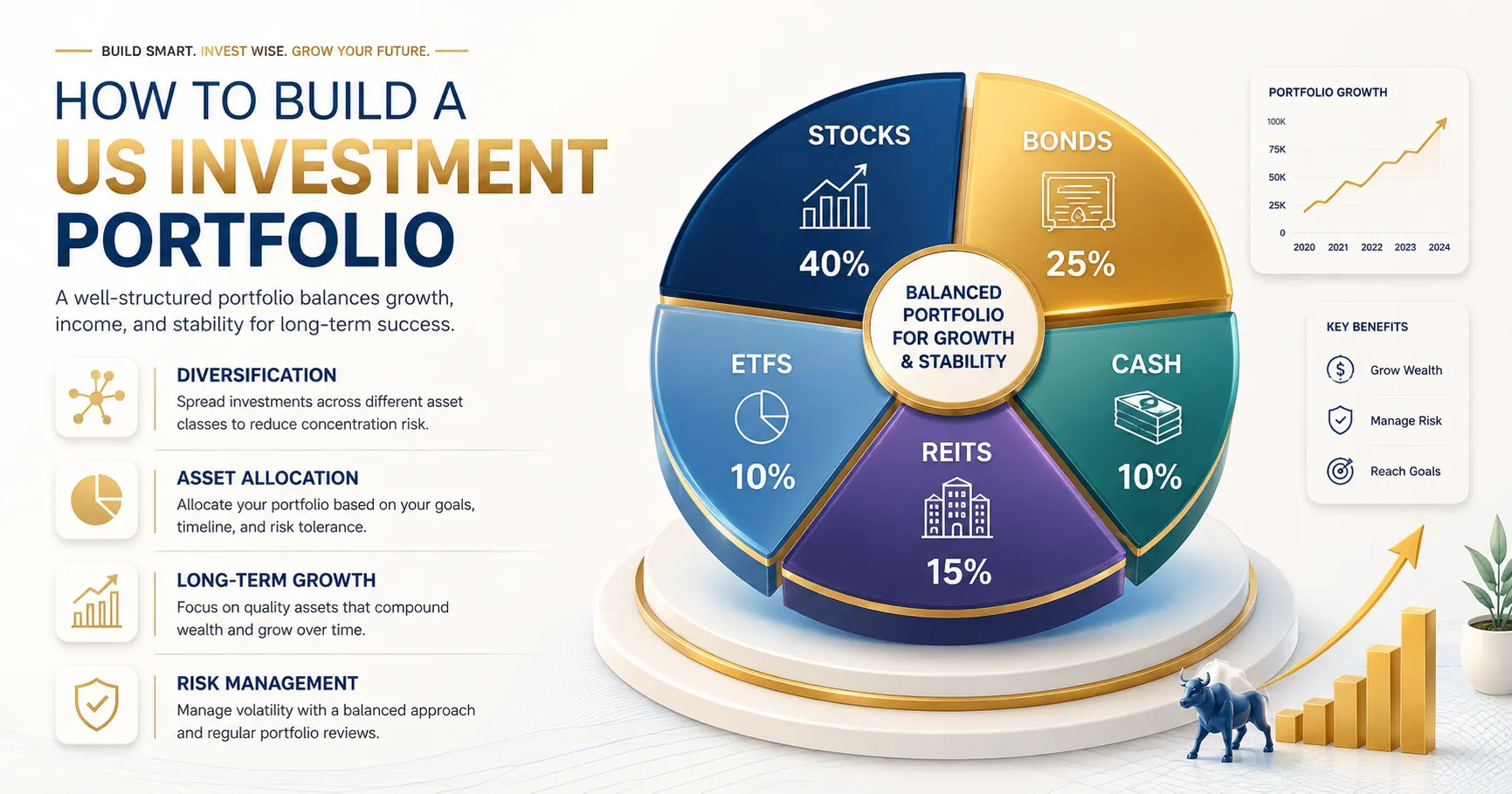
Building an investment portfolio means assembling a collection of assets, stocks, bonds, ETFs, and cash, in proportions matched to your goals, time horizon, and risk tolerance. The portfolio is not the individual investments; it is the structure that determines how those investments interact with each other and with your specific financial situation. This guide explains the core principles, the most practical starting frameworks, and the common mistakes that undermine even well-intentioned portfolios.
Step 1: Define Your Goals and Time Horizon
A portfolio built for retirement 30 years away is structured very differently from one built to fund a home purchase in 5 years. Time horizon is the single most important variable in asset allocation. Longer time horizon (10+ years): can tolerate more volatility because short-term drawdowns have time to recover; higher equity allocation appropriate. Medium time horizon (5-10 years): some equity exposure with increasing bond/stable allocation as the goal approaches. Short time horizon (under 5 years): capital preservation matters more than growth; high-volatility assets carry meaningful risk of being worth less when needed. Before selecting any investment, answer: when do I need this money, and what happens to my plan if it temporarily falls 30-40%?
Step 2: Choose the Right Account Types
401(k)/403(b): employer-sponsored retirement accounts. Traditional = pre-tax contributions, taxed on withdrawal. Roth = after-tax contributions, tax-free growth and withdrawal. Always contribute enough to capture the full employer match first; it is an immediate 50-100% return on that contribution. Roth IRA: after-tax contributions; qualified withdrawals are completely tax-free. 2026 contribution limit: $7,000 ($8,000 if age 50+). Income limits apply. Traditional IRA: pre-tax contributions (if deductible); taxed on withdrawal. Same contribution limits as Roth. Taxable brokerage account: no contribution limits, no tax advantages, but complete flexibility. The sequence: employer 401(k) to match, then Roth IRA to limit, then back to 401(k) to limit, then taxable account.
Step 3: Determine Asset Allocation
A common rule of thumb: subtract your age from 110 to get your approximate stock allocation. A 30-year-old = ~80% stocks, 20% bonds. This is a starting framework, not a precise prescription.
| Risk Profile | Stocks | Bonds | Cash/Stable |
|---|---|---|---|
| Aggressive (long horizon, high risk tolerance) | 90-100% | 0-10% | 0% |
| Moderate (10-20yr horizon) | 60-80% | 20-40% | 0-5% |
| Conservative (short horizon or low risk tolerance) | 20-40% | 40-60% | 10-20% |
Step 4: Select the Investments
The three-fund portfolio (classic beginner structure): 1) VTI (Vanguard Total Stock Market ETF, 0.03%) or VOO (S&P 500, 0.03%) for US equity core; 2) VXUS (Vanguard Total International Stock ETF, 0.07%) for international diversification; 3) BND (Vanguard Total Bond Market ETF, 0.03%) for fixed income stability. Proportions depend on the allocation decided in Step 3. Tax placement: hold BND (bond ETF) inside a Roth IRA or 401(k) where interest income is not taxed; hold VTI and VXUS in taxable accounts where they generate minimal taxable distributions.
Step 5: Automate Contributions and Rebalance
Dollar-cost averaging (DCA): invest a fixed amount on a consistent schedule regardless of market conditions. Most brokerages support automatic investment that executes this with no manual action required. Rebalancing: over time, market movements shift allocation away from targets. Annual or semi-annual rebalancing restores the intended risk profile. Rebalance inside tax-advantaged accounts when possible to avoid triggering taxable events.
What Not to Do
Chase performance. Last year’s best-performing sector is frequently the worst performer the following year. Over-complicate. Three funds is genuinely sufficient for full diversification. Stop investing during downturns. Market downturns during DCA produce more shares at lower prices; stopping contributions during fearful moments is the worst possible timing for long-run compounding. Ignore emergency fund separation. Three to six months of expenses in a high-yield savings account should exist separately before substantial portfolio investing begins.
Our Take
Building a US investment portfolio starts with defining goals and time horizon, selecting the right account types to maximize tax efficiency, setting an asset allocation matched to risk tolerance, and populating that allocation with a small number of low-cost index ETFs. The three-fund portfolio covers everything necessary for most beginners, and consistent DCA contributions maintained through market downturns are more valuable than any specific investment selection decision.
This article is for informational and educational purposes only and does not constitute financial or investment advice. Always conduct your own research and consult a qualified financial advisor.
Frequently Asked Questions
