Forex Spread Behavior During News Events Explained

- Regime switching means financial markets, including forex, do not behave according to a single fixed statistical process over time, but instead shift between distinct phases or "regimes"
- Markov-switching models, originally developed by Hamilton in the late 1980s, treat the market as moving through a small number of discrete states, each with its own return and volatility characteristics
- Hidden Markov Models (HMMs) assume the current regime is unobservable and must be inferred statistically from observable data such as returns, volatility and trend indicators
- Regime-switching models have been extended to incorporate volatility specifically, including Markov-switching ARCH and GARCH models, which have been applied to forecast volatility in markets including gold futures
- A documented limitation is that Markov-switching models can produce false confidence after a genuine structural break, continuing to assign states even after the underlying meaning of those states has drifted from reality
- Regime-switching applications extend beyond forex to commodities, fixed income and equities, with research applying these models to currency rates, interest rates, and stock-futures relationships
- More recent alternatives, such as statistical jump models, have been developed specifically to improve regime persistence by penalizing excessive state transitions compared with traditional Markov-switching approaches
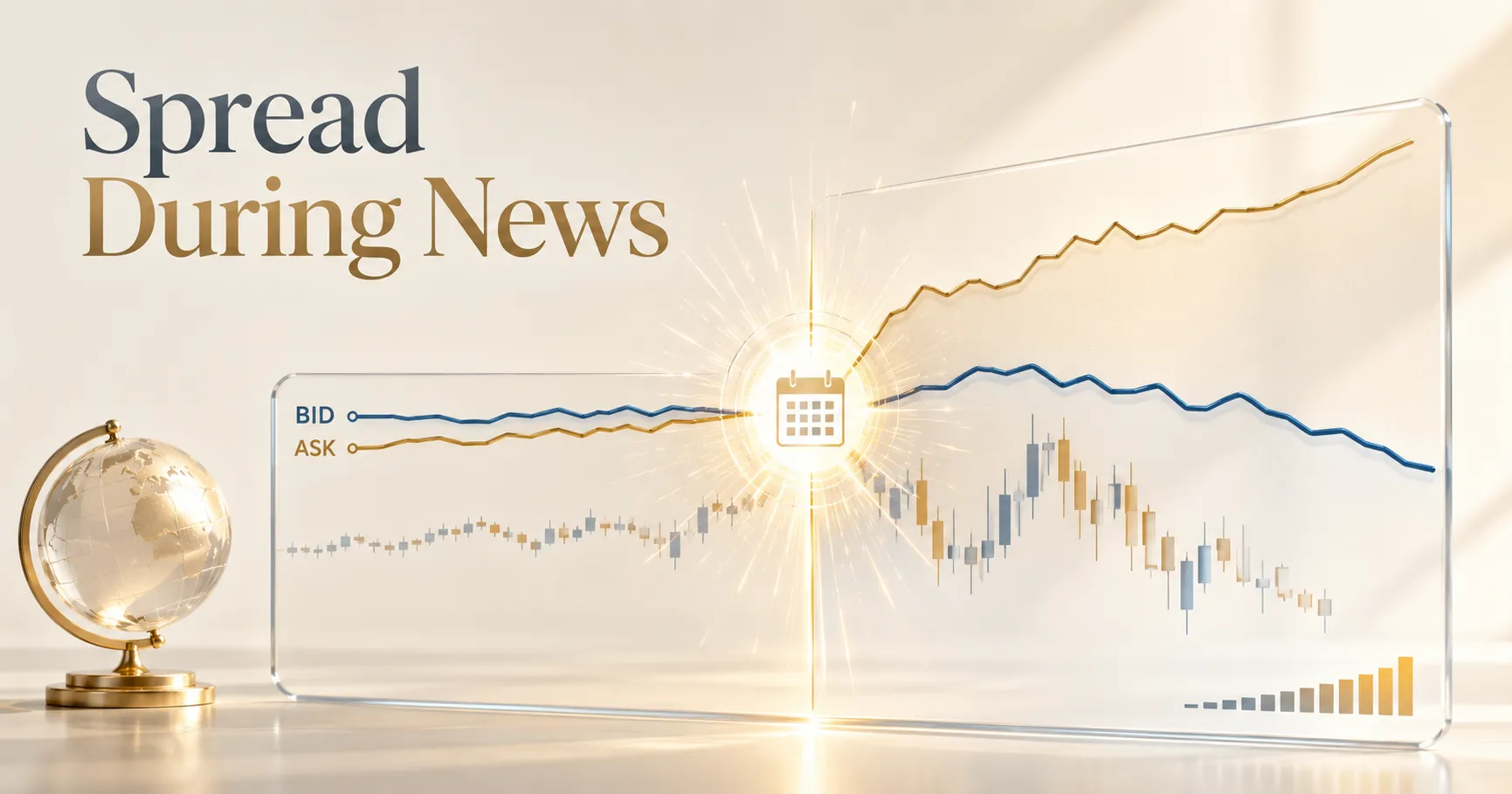
Forex spreads widen sharply during major news events because liquidity providers withdraw or reduce exposure to protect themselves from sudden, unpredictable price moves. A typical EUR/USD spread of around 1 pip can widen to 3-5 pips in the 5-15 minutes before a high-impact release, and can spike to 20-50 pips or more at the moment of release itself, before gradually normalizing over the following minutes. This guide explains the mechanics behind spread widening, what happens minute by minute around a release, and practical ways to manage the added cost and risk.
Why Spreads Widen During News Events
The spread is the difference between the bid price and the ask price, representing the basic transaction cost of any forex trade. Under normal conditions, spreads stay narrow because multiple liquidity providers compete to offer the tightest possible price. News events disrupt this competitive balance through a specific mechanism.
As a major release approaches, liquidity providers face genuine uncertainty about where the price will move once new information hits the market. To protect themselves from being caught on the wrong side of a sudden price jump, they pull back their resting orders or widen the gap between their bid and ask quotes. With fewer competing quotes available at tight prices, the effective spread a trader sees widens, sometimes dramatically.
This is not typically a deliberate broker manipulation, though the effect can feel that way to a trader watching their execution price slip. During news events, this effect compounds because many liquidity providers are simultaneously stepping back at once.
The Minute-by-Minute Timeline Around a Release
Spread widening around a scheduled news event follows a fairly consistent pattern, though the exact magnitude varies by currency pair and the significance of the specific release.
| Timing | Typical Spread Behavior |
|---|---|
| 5-15 minutes before release | Spreads begin widening as liquidity providers reduce exposure; a 1-pip EUR/USD spread might move to 3-5 pips |
| At the moment of release | Spreads can explode to 20-50+ pips; prices gap; market depth can disappear briefly |
| 1-5 minutes after release | Spreads gradually narrow as the initial reaction settles and market makers reassess the new price level |
| 5-30 minutes after release | Spreads continue normalizing but often remain somewhat elevated above pre-news baseline levels |
This pattern applies most clearly to scheduled, high-impact releases. Unscheduled news, such as a surprise geopolitical event, can produce a similar spread reaction but without the predictable lead-up window that traders can prepare for in advance.
Which Events Cause the Most Spread Widening
Not all economic releases carry equal weight. The events most consistently associated with significant spread widening share a common trait: they materially shift expectations about a major economy’s growth, inflation, or monetary policy trajectory.
Non-Farm Payrolls (NFP) is released monthly, typically on the first Friday of each month, and reports US employment figures. Inflation reports (CPI) directly influence expectations about future central bank policy. GDP releases tend to move currencies most when the actual figure diverges meaningfully from consensus expectations. Central bank interest rate decisions carry some of the largest spread and volatility impacts of any scheduled event.
A critical nuance: it is not the headline figure in isolation that drives the reaction, but the gap between the actual result and what was already priced into the market through consensus expectations.
Spread Widening on Gold and Volatile Instruments
Spread behavior is not uniform across all instruments. Gold (XAU/USD) is a notable example of an asset where spreads can widen even more dramatically than on major currency pairs during volatile conditions.
A normal gold spread of around 10 pips can jump to 50 pips or more in seconds during a sharp price move, since gold’s price action tends to be sharper and brokers often widen spreads more defensively on this instrument compared with deeply liquid major forex pairs.
Spread Widening Beyond News: Time of Day Effects
News events are not the only driver of spread widening. Liquidity, and therefore spread width, also varies systematically by time of day, independent of any scheduled release.
Spreads tend to be tightest during the London-New York session overlap, when liquidity from the world’s two largest financial centers is simultaneously available. Conversely, spreads tend to widen during the Asian session and around market open and close.
This means a news release that happens to fall during an already low-liquidity window can produce more extreme spread widening than the same release would during the London-New York overlap.
Practical Risk Management Around News Events
Avoid opening new positions immediately before high-impact releases. Since spreads begin widening 5-15 minutes ahead of a release, entering a position in this window means immediately absorbing a larger-than-normal transaction cost.
Use limit orders rather than market orders during volatile periods. A market order during a news spike can fill at a significantly worse price than expected.
Consider waiting for the post-release retracement. Spreads tend to revert toward their normal range within a few minutes after release.
Reduce position size during scheduled high-impact events. Smaller positions limit the dollar impact of both the wider spread and any slippage.
Keep an economic calendar and check it before trading. Knowing which specific releases are scheduled allows a trader to deliberately plan around these windows.
Who Should Pay Closest Attention to This Pattern?
| Trader Profile | Relevance of Spread Widening Awareness |
|---|---|
| Scalpers and very short-term traders | Very high. Wide spreads can erase the thin profit margins these strategies depend on |
| News/event-driven traders | High, but as an accepted cost of the strategy rather than something to avoid entirely |
| Swing traders holding for days | Moderate. A single wide-spread entry matters less relative to the overall trade duration |
| Long-term position traders | Lower. Entry timing around a single news event has limited impact on multi-week or multi-month positions |
Our Take
Regime switching captures a genuine and well-documented feature of forex markets: currency pairs do not move through one continuous, statistically stable process, but instead shift between distinct phases with different return and volatility characteristics. Markov-switching models and Hidden Markov Models provide the foundational toolkit for detecting these regimes, with extensions into volatility modeling (Markov-switching GARCH) and cross-asset frameworks expanding their practical applicability well beyond the original macroeconomic context in which they were developed.
For forex traders specifically, the practical value lies in using detected regime information to inform strategy selection and risk exposure, recognizing that a single fixed approach is unlikely to perform consistently across both calm and turbulent market phases. At the same time, traders should remain aware of the documented limitations, particularly the risk of false confidence following genuine structural breaks and the inherent detection lag present in any model that infers regimes from accumulated statistical evidence rather than observing them directly.
This article is for informational and educational purposes only and does not constitute financial or trading advice. Quantitative models such as regime-switching frameworks carry inherent limitations and should not be relied upon as a sole basis for trading decisions.
Frequently Asked Questions
