How US Interest Rates Affect Markets

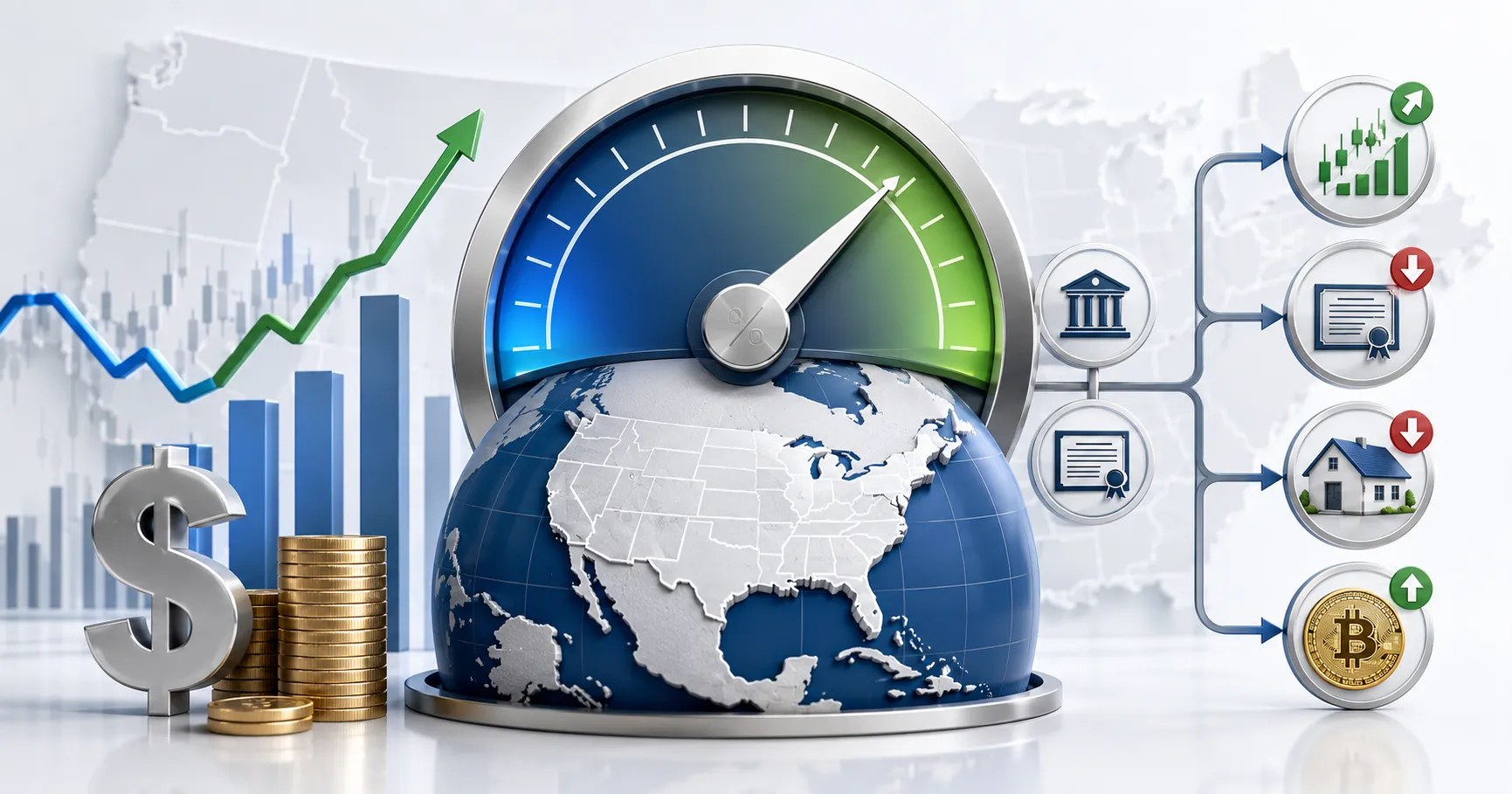
- The Federal Reserve's benchmark rate (federal funds rate) sets the floor for borrowing costs across the entire US economy
- Rate hikes slow growth and reduce inflation; rate cuts stimulate growth but risk reigniting inflation
- Stocks, bonds, real estate, and the USD all move in predictable (though not guaranteed) directions when rates change
- The yield curve - the spread between short and long-term rates - is one of the most watched recession indicators in finance
When the Federal Reserve raises or lowers its benchmark interest rate, the effect ripples through every asset class: stocks, bonds, real estate, forex, and crypto all reprice in response. Understanding this mechanism is foundational to macro-aware investing. This guide explains how the Fed rate works, why markets move when it changes, and how each major asset class responds.
How the Federal Reserve Sets Rates
The Federal Open Market Committee (FOMC) meets eight times per year and votes on the federal funds rate, the overnight lending rate between banks. This rate sets a floor for all borrowing costs in the economy. When the Fed raises this rate, borrowing becomes more expensive across the board. When it cuts, credit becomes cheaper. The Fed has a dual mandate: maximum employment and price stability (targeting approximately 2% inflation). Rate decisions reflect which mandate is under more pressure at any given time. Rate hike cycle: when inflation is above target or the economy is overheating, the Fed raises rates to cool demand, slow lending, and reduce price pressure. Rate cut cycle: when unemployment rises or growth slows dangerously, the Fed cuts rates to stimulate borrowing, spending, and investment. Monetary policy works with a lag; changes in rates typically take 12-18 months to fully transmit through the economy.
Impact on Stocks
Interest rates affect equities through two channels: the discount rate and earnings. Discount rate effect: stock valuations are built on discounted cash flow models. When the risk-free rate rises, future earnings are worth less in present value terms, compressing valuations especially for growth stocks. Earnings effect: higher rates increase borrowing costs for companies, compressing margins; consumer spending slows, reducing revenue. Sector divergence: financials (banks) often benefit from rate hikes through wider net interest margins; utilities and real estate typically underperform during rate hikes (yield competition); technology and growth stocks are most sensitive to rate increases; consumer staples and healthcare are more defensive. Rate cuts generally act as a tailwind for stocks, particularly growth stocks.
Impact on Bonds
The relationship between interest rates and bond prices is inverse and mechanical: when rates rise, existing bond prices fall; when rates fall, existing bond prices rise. A bond paying 3% becomes less attractive when new bonds yield 5%; its price falls until the effective yield matches the market rate. Duration risk: longer-dated bonds are more sensitive to rate changes. A 30-year Treasury loses far more value in a rate hike cycle than a 2-year Treasury. The yield curve: the spread between 2-year and 10-year Treasury yields is one of the most watched indicators in finance. An inverted yield curve, where short rates exceed long rates, has preceded every US recession since 1950, though the lead time varies from 6 to 24 months.
Impact on Real Estate
Higher interest rates raise mortgage rates, reducing homebuyer affordability and putting downward pressure on home prices. For commercial real estate, higher rates also increase cap rates (the required return on property), compressing valuations. REITs (Real Estate Investment Trusts) are particularly sensitive because they are often valued as yield instruments; when bond yields rise, REIT yields must rise too, meaning REIT prices fall. Rate cuts reverse this: lower mortgage rates increase affordability, stimulate demand, and typically support both home prices and REIT valuations.
Impact on the US Dollar
Rate differentials between the US and other countries drive currency flows. When the Fed raises rates while other central banks hold or cut, the yield advantage on US dollar assets attracts foreign capital, strengthening the USD. A stronger USD makes US exports more expensive globally, reduces the dollar value of foreign earnings, and puts pressure on emerging market currencies and debt denominated in dollars. In 2022, aggressive Fed hikes drove the DXY Dollar Index to 20-year highs, causing significant stress in emerging market economies with large USD-denominated debt loads.
Impact on Crypto
Bitcoin and other cryptocurrencies have shown meaningful sensitivity to US rate expectations, particularly since the 2024 spot ETF approval deepened institutional integration with traditional finance. Rate hikes typically reduce risk appetite, drawing capital toward safer yield-bearing assets and away from speculative ones. Rate cuts, or expectations of cuts, have historically been associated with risk-on rallies that benefit crypto alongside growth stocks. The correlation is imperfect: crypto’s own cycle dynamics (halvings, on-chain metrics, regulatory developments) can override macro rate sensitivity for extended periods.
How to Use Rate Awareness in Practice
Watch FOMC meeting dates. The eight annual meetings are pre-scheduled. Markets often move significantly in the days around these dates, both in anticipation and in response to the actual decision and press conference language. Track the dot plot. The Fed publishes a “dot plot” showing each FOMC member’s projection for where rates will be over the next several years. Changes in the dot plot often matter as much as the actual rate decision. Monitor inflation data. CPI (Consumer Price Index) and PCE (Personal Consumption Expenditures) releases are the primary inputs feeding Fed rate decisions. Sector rotation. Rising rate environments favor financials and energy; falling rate environments favor technology and real estate.
Our Take
US interest rate decisions by the Federal Reserve are the single most important macro variable in global financial markets. Every asset class – stocks, bonds, real estate, currency, and increasingly crypto – reprices in response to rate changes and to expectations about future rate direction. Understanding the direction, pace, and rationale of Fed policy is not a substitute for investment analysis, but it provides an essential macro backdrop against which all other analysis operates.
This article is for informational and educational purposes only and does not constitute financial or investment advice. Always conduct your own research and consult a qualified financial advisor.
Frequently Asked Questions
