UAE Session Overlap Trading: Finding the Edge

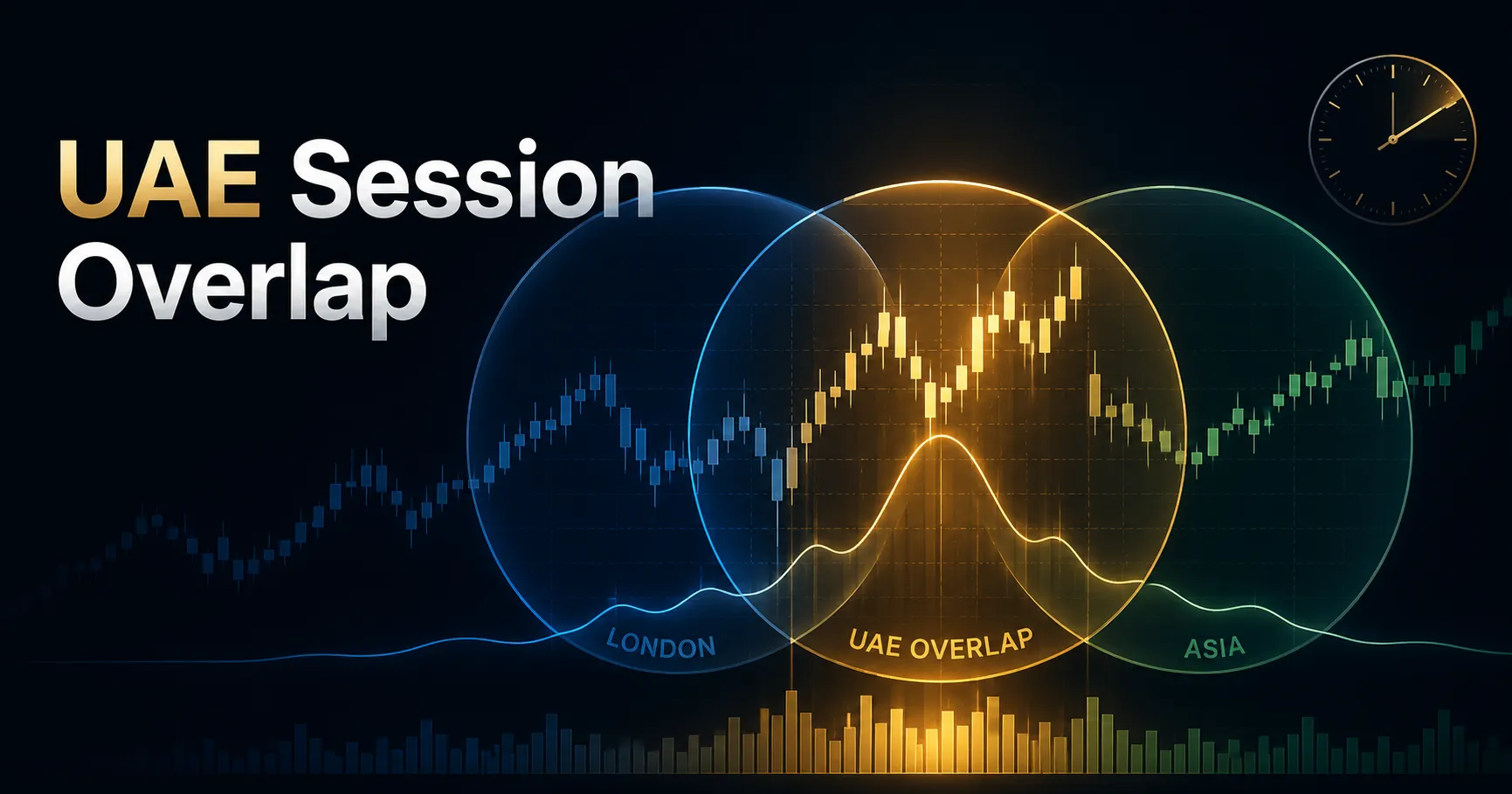
- The London-New York overlap (roughly 4:00-8:00 PM GST, shifting seasonally) is the highest-liquidity window of the forex trading day, and UAE's time zone places it conveniently in the early evening
- More than 50% of total global forex volume is estimated to occur during the combined London-New York session activity
- The overlap favors breakout and momentum strategies, since genuine directional moves are more likely to sustain when liquidity is deep
- The overlap can work against pure mean-reversion strategies that depend on calm, range-bound price action, since volatility during this window tends to be elevated
- A documented "U-shaped" or "M-shaped" intraday volatility pattern shows volatility peaks around major session opens, including the London and New York opens specifically, with research finding cryptocurrencies exhibit a similar pattern to forex
- UAE traders gain a structural advantage over many other time zones, since this peak window falls during normal waking hours rather than overnight
- The edge erodes if traded mechanically; combining the overlap window with a specific strategy type tailored to high-liquidity, high-volatility conditions extracts more value than simply being present during the window
The UAE session overlap trading edge comes from the London-New York window, roughly 4:00-8:00 PM GST, where liquidity peaks, spreads compress, and price action becomes more directional, conditions that disproportionately benefit specific strategy types over others. The edge is not simply “trade more during this window” but understanding which strategies the overlap actually favors (breakout and momentum approaches) versus which it can hurt (mean-reversion approaches expecting calm, range-bound conditions). This guide goes beyond session timing to explain how to structure a trading approach specifically around the UAE’s overlap advantage.
Why “Trade During the Overlap” Is Necessary But Not Sufficient
Most session-timing guides stop at identifying when liquidity peaks. That information alone is not a trading edge; it is a description of market conditions. A genuine edge requires matching a specific strategy type to what those conditions actually favor.
During the London-New York overlap, two things happen simultaneously: liquidity deepens and volatility tends to rise. These two conditions favor certain strategy types and work against others. Treating the overlap as uniformly “good for trading” without this distinction means a trader may be applying the wrong strategy to favorable conditions and still underperforming.
What the Overlap Structurally Favors
Breakout strategies benefit directly from deep liquidity during genuine directional moves. A breakout attempted during a thin-liquidity period can fail or reverse simply because there is not enough participation to sustain the move; the same breakout during the overlap has a better statistical chance of following through.
Momentum and trend-continuation strategies similarly benefit from the overlap’s tendency toward more decisive, sustained price action, compared with quieter periods where price often drifts without commitment.
News and event-driven strategies benefit structurally as well, since major US economic releases fall within the New York session, meaning the overlap window captures both the deepest liquidity and the highest concentration of market-moving scheduled events.
What the Overlap Can Work Against
Pure mean-reversion strategies that depend on price oscillating predictably within a calm range can struggle during the overlap specifically because the window’s elevated volatility makes ranges less stable.
Tight, fixed-stop scalping strategies not specifically calibrated for overlap conditions can suffer more frequent stop-outs, since the same volatility that creates opportunity also increases the chance that price temporarily moves through a tightly placed stop.
This is the central, often-overlooked nuance: the overlap is not universally good for every strategy.
The Documented Intraday Volatility Shape
Academic and practitioner research has consistently documented that intraday volatility does not stay flat throughout the trading day, but instead follows a recognizable shape tied to session opens and closes.
In traditional markets, research has long documented a U-shaped intraday pattern, where volatility, trading volume, and bid-ask spreads are elevated near the market’s opening and closing hours. For 24-hour markets like forex, a related M-shaped pattern has been documented, with volatility spikes clustering specifically around the opening hours of major financial centers, notably London and New York.
Notably, research examining cryptocurrency intraday volatility has found that conventional cryptocurrencies exhibit a volatility pattern resembling this same M-shaped behavior seen in forex.
| Pattern Type | Markets Where Documented | Key Characteristic |
|---|---|---|
| U-shaped | Traditional equities (single market open/close) | Elevated volatility at open and close, lower at midday |
| M-shaped | Forex, and partially observed in crypto | Volatility spikes around multiple session opens (London, New York) |
Building a UAE-Specific Overlap Strategy
Step 1: Define your strategy type before the session, not during it. Decide in advance whether you are running a breakout, momentum, or news-reactive approach for that day’s overlap window.
Step 2: Widen stop distances relative to quieter-session baselines. A stop distance calibrated for the calmer Asian session is likely too tight for the overlap window.
Step 3: Avoid forcing range-bound setups into this window. If your edge depends on calm, predictable ranges, consider whether the Asian session might suit that approach better.
Step 4: Layer in the economic calendar. Since major US data releases concentrate within the New York session, check what is scheduled before committing to a specific intraday plan.
Step 5: Track results separately by strategy type. Reviewing performance specifically by strategy type during this window reveals which of your approaches are actually capturing the structural advantage.
Who Benefits Most from This UAE-Specific Edge?
| Trader Profile | Overlap Edge Relevance |
|---|---|
| Breakout and momentum day traders | High. Directly benefits from the overlap’s liquidity and directional conviction |
| News/event-driven traders | High. Captures both peak liquidity and the concentration of US scheduled releases |
| Mean-reversion/range traders | Lower, and potentially negative if forced into this specific window without adaptation |
| Long-term swing or position traders | Moderate. Entry timing within a single overlap session matters less to a multi-day thesis |
Our Take
The genuine UAE session overlap edge is not simply showing up during the London-New York window; it lies in matching a specific strategy type, breakout, momentum, or news-driven, to the structural conditions that window actually creates: deep liquidity paired with elevated, directional volatility. UAE-based traders hold a real geographic advantage in that this peak window falls during normal evening hours rather than overnight, but extracting value from that advantage requires deliberately building a strategy suited to high-liquidity, high-volatility conditions rather than applying an unrelated approach simply because the clock says it is time to trade.
This article is for informational and educational purposes only and does not constitute financial or trading advice. Trading forex and other leveraged instruments carries risk of loss. Always conduct your own research and consult a qualified financial advisor before making trading decisions.
Frequently Asked Questions
