UAE Stock Market Guide: DFM, ADX, and NASDAQ Dubai Explained


- UAE operates three exchanges: DFM (Dubai), ADX (Abu Dhabi), and NASDAQ Dubai (international listings, DIFC-based)
- Zero personal capital gains tax and zero personal income tax on equity gains for individual investors
- All investors (residents and non-residents) require a free National Investor Number (NIN) before trading on DFM or ADX
- Settlement is T+2 (two business days), and a Delivery versus Payment (DvP) system ensures simultaneous exchange of securities and cash
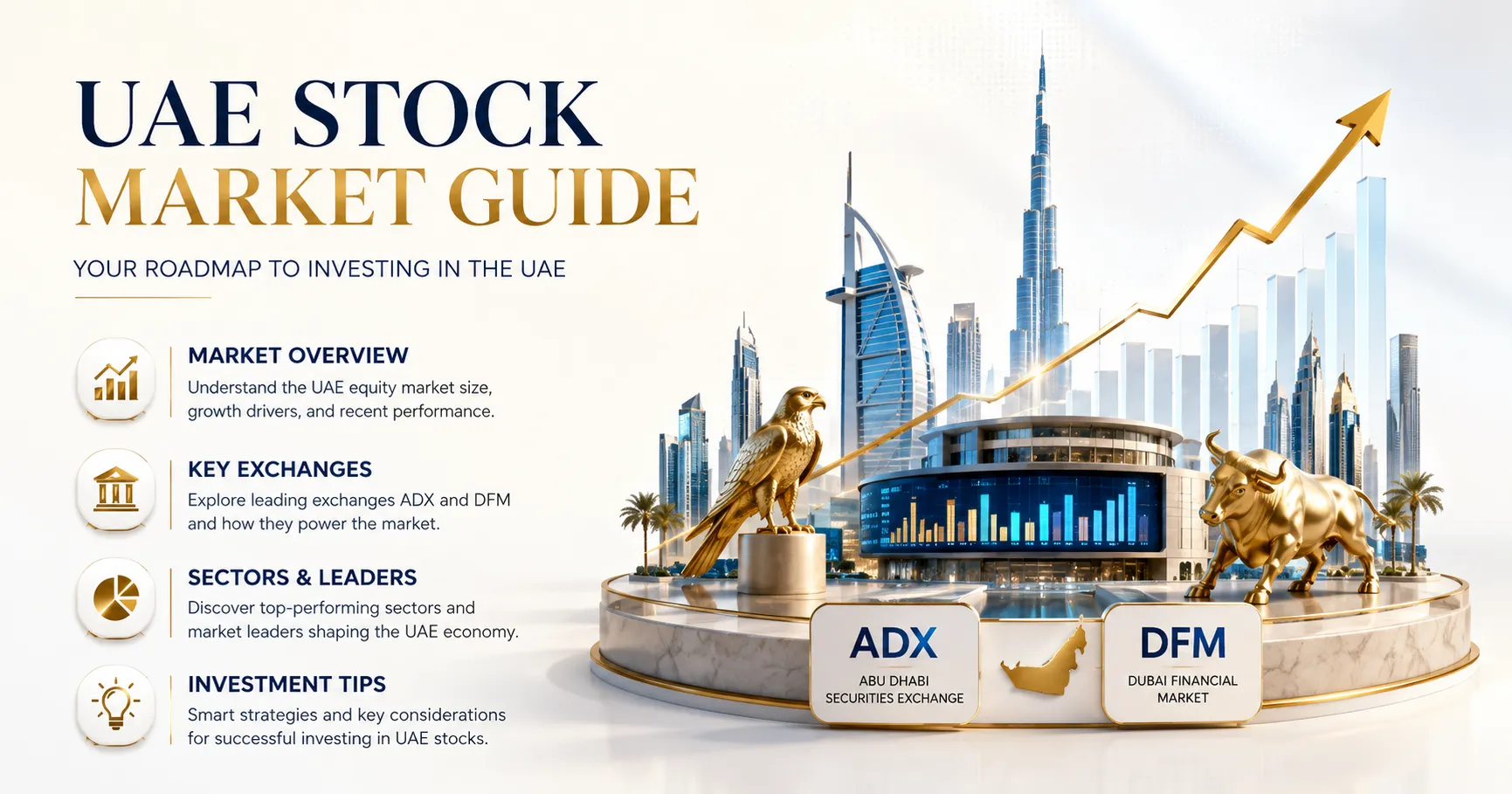
The UAE operates three main stock exchanges: the Dubai Financial Market (DFM), the Abu Dhabi Securities Exchange (ADX), and NASDAQ Dubai. Together they list over 100 companies and form one of the most dynamic equity markets in the Gulf Cooperation Council (GCC). The UAE imposes no personal capital gains tax or income tax on equity investment profits, making it one of the most tax-efficient equity markets in the world for individual investors.
The Three UAE Exchanges
Dubai Financial Market (DFM) was established in 2000 and trades equities, bonds, sukuk (Islamic bonds), and ETFs. DFM operates from Sunday to Thursday and is heavily weighted toward real estate, banking, and financial services. Emaar Properties, Emirates NBD, and Dubai Islamic Bank are among its most actively traded stocks. The DFMGI is the benchmark index. Abu Dhabi Securities Exchange (ADX) is the larger exchange by total market capitalization, driven significantly by ADNOC (Abu Dhabi National Oil Company) and First Abu Dhabi Bank. It also operates Sunday to Thursday. NASDAQ Dubai is based in the DIFC and regulated by the DFSA. It lists international equities, GCC stocks, and sukuk instruments, catering more to institutional and international investors.
| Exchange | Location | Regulator | Key Characteristic |
|---|---|---|---|
| DFM | Dubai | CMA (formerly SCA) | Real estate, banking, services heavy |
| ADX | Abu Dhabi | CMA (formerly SCA) | Largest by market cap; ADNOC, FAB dominant |
| NASDAQ Dubai | DIFC, Dubai | DFSA | International listings, sukuk, institutional |
Note: The UAE securities regulator was renamed from SCA (Securities and Commodities Authority) to CMA (Capital Markets Authority) effective January 1, 2026.
How to Start Investing: The NIN
A National Investor Number (NIN) is mandatory for all investors before any trade can be executed on DFM or ADX. The NIN is free to obtain. How to get a NIN: through the DFM investor services portal or mobile app, or through a licensed UAE broker as part of account opening. The process is fully digital; required documents are passport copy for non-residents and Emirates ID plus passport for residents. Processing time is typically 1-3 business days. Once issued, the NIN is permanent and used for all future transactions on UAE exchanges.
Settlement and Market Structure
UAE exchanges operate on T+2 settlement, meaning trades settle two business days after execution. Cash from a sale is not available until settlement completes. Trading hours (DFM and ADX): Sunday to Thursday. Pre-market 9:30 AM-10:00 AM UAE time. Regular session: 10:00 AM-2:00 PM UAE time (DFM) / 10:00 AM-2:30 PM (ADX). Delivery versus Payment (DvP): transactions clear through a simultaneous exchange of securities and cash, protecting both buyer and seller from counterparty risk.
Market Characteristics: What Makes UAE Different
Government-linked dominance: a significant portion of listed UAE market cap is held by government-related entities (sovereign wealth funds, state-owned enterprises, and government holding companies), creating a more concentrated market than a Western index. Sector concentration: UAE markets are heavily weighted toward real estate, banking and financials, telecom, and energy. Technology and consumer discretionary sectors are underrepresented compared to global benchmarks. Islamic finance integration: many listed instruments follow Sharia-compliant structures; sukuk trade alongside conventional bonds. Foreign ownership limits: some UAE-listed companies cap the percentage of shares that can be held by foreign investors, though these limits have been progressively relaxed.
Tax Treatment
Individual investors in UAE-listed equities enjoy zero capital gains tax on profits from selling shares, zero personal income tax on dividends received, and no requirement to file a personal tax return for investment gains. The UAE’s 9% corporate tax (effective June 2023) applies to businesses and corporations, not to individual investors’ personal investment income.
Our Take
UAE stock markets offer tax-free individual equity investment with an accessible entry process (free NIN, digital application), but are structurally concentrated in banking, real estate, and government-linked entities – very different from a diversified global index. For UAE-based and international investors seeking Gulf market exposure, understanding this sector concentration, the T+2 settlement cycle, and the NIN requirement covers the foundational mechanics needed before placing a first trade.
This article is for informational and educational purposes only and does not constitute financial or investment advice. Always conduct your own research and consult a qualified financial advisor.
Frequently Asked Questions
